Wednesday, September 25, 2019

The 100 Best Books of the 21st Century - The Guardian

Britain's The Guardian newspaper has an interesting article titled "The 100 Best Books of the 21st Century" that caught my eye this morning. Essentially, of course, it is a list of what the newspaper considers to be the best books of the past two decades, meaning that something like 80% of the books on today's list are likely to be gone by the turn of the 22nd century.

The entire list can be found here. It's beautifully done, so take a look at it.

Of the Top 10, I've only read number 2, Marilynne Robinson's 2004 novel Gilead. That this one is on the list is not much of a surprise because it won the Pulitzer Prize for Fiction in 2005. I am a bit surprised that it rates this highly, though. From The Guardian: "Robinson’s meditative, deeply philosophical novel is told through letters written by elderly preacher John Ames in the 1950s to his young son who, when he finally reaches an adulthood his father won’t see, will at least have this posthumous one-sided conversation."

I seem to have done much better with the second ten on the list, having read six of them starting with number 11, My Brilliant Friend by the mysterious Italian author who uses the pen name Elena Ferrante. My Brilliant Friend is part of a four-book series that kept me reading for several weeks and was one of my favorite books of 2012. The other five I read were: Number 12, Philip Roth's The Plot Against America (2004); Number 13, Barbara Ehrenreich's Nickel and Dimed (2001); Number 17, Cormac McCarthy's The Road (2006); Number 19, Mike Haddon's The Curious Incident of the Dog in the Night-Time (2003); and Number 20, Kate Atkinson's Life After Life (2013).

Of the next twenty (31-40), I've read only three: Number 22, Tenth of December by George Saunders (2013), Number 30, The Underground Railroad by Colson Whitehead (2016), and Number 40, The Year of Magical Thinking by Joan Dideon (2005). The Whitehead book is one of my all-time favorites and it, of course, won the Pulitzer Prize for Fiction in 2017. I still think about that one sometimes because of the audacious approach Whitehead uses to make his completely serious points about slavery and its aftermath. It is brilliant.

Again, of the next twenty (41-60), I've only managed three of them: Number 41, Ian McEwan's Atonement (2001), Number 42, Moneyball by Michael Lewis (2010), and Number 51, Colm Tóibín's Brooklyn (2009). These three fall right into my wheelhouse because I'm a huge fan of both McEwan and Tóibín and I'm always on the lookout for a good baseball book, especially something like this groundbreaking one from Lewis. Really, what surprises me here is that a baseball book showed up at all on a "Best of" booklist in a British newspaper. That's kind of cool.

I didn't even do that well on the next twenty (61-80), having read only one of them and abandoned one other that only irritated me more with every page I turned. The one I read is: Number 64, Stephen King's wonderful book on writing appropriately titled On Writing (2000). The one that I found unreadable enough to give up on it despite all its hype was Gone Girl by Gillian Flynn. (That one is my candidate to be the first one to drop off the list next time its updated.)

And then there are the final twenty - and I can add only one of them to my list of ones read. It's The Tipping Point by Malcolm Gladwell   (2000) which came in at Number 94.  I've read all the recent Gladwell books and have enjoyed each of them, but I'm starting to hear rumblings that his star is becoming a bit tarnished these days. Interestingly Harry Potter and the Goblet of Fire (2000) comes in at number 97 (well, that surprises me) and I spotted a Jim Crace novel I didn't know about, 2013's Harvest at number 81. That one will be added to my TBR for sure.

So there you have it, a mere 15 out of the top 100 books of the past two decades. I realize that this is a British newspaper's list, but I read a whole lot of British literature and nonfiction so I'm still a little disappointed in myself. Anyway, take a look at the list by clicking on that link up above because you might very well spot something you want to add to your own TBR list. Good stuff here.

Monday, September 23, 2019

A Necessary End (Inspector Banks No. 3) - Peter Robinson

A Necessary End is book number three in Peter Robinson’s twenty-six-book-long Inspector Banks series. By the beginning of this one, Banks has comfortably settled into his Yorkshire surroundings and much prefers his new job to the one he left behind in London. The locals consider him to be a likeable enough guy, and more importantly, an honest cop who doesn’t cross the line. But when Scotland Yard sends a hotshot cop up to Yorkshire to take over a murder investigation, all of that is suddenly in jeopardy because the London cop is the exact opposite of Banks and doesn’t care who might object to his behavior. 

What should have been a small, peaceful demonstration in little Eastvale goes suddenly wrong when a policeman is stabbed to death during a confrontation between 100 demonstrators and the handful of police on hand to keep them under control. CID Superintendent Richard Burgess makes it perfectly clear upon his arrival from London that someone is going to pay for the crime – and the sooner the better because he can’t wait to get back to civilization. Banks, when he figures out that Burgess will build a case against the easiest target he spots, regardless of actual guilt, makes the potentially career-damaging decision to run his own parallel investigation behind the superintendent’s  back.

So, did the policeman die because one of the demonstrators just happened to pull a knife during the fight or is there more to the man’s murder? As it turns out, the young cop had a reputation for taking the opportunity to bash a few heads with his baton every chance he got and particularly enjoyed working demonstrations and protest marches. Had any of the demonstrators had a previous run-in with him - and a whole different motive for pulling that knife? Or not? The murder may just be a whole lot more complicated than Burgess wants to admit – and every bit as complicated as Banks fears it is.

Peter Robinson
The author does not add much to the Banks character in A Necessary End, and his wife and children are still pretty much blank slates in this third book. In fact, the whole family is out of town during the entire novel and their only communication with Banks is via short evening telephone calls. We do learn that Banks sees his job “as a defender of the people, not an attacker” and that he is now thirty-eight-years-old. But Robinson keeps Banks real by making sure that he is a long way from being perfect, as illustrated by what Banks reveals about himself to Burgess during one of their numerous pub-fueled conversations: “I don’t like violence. I’ll use it if I have to, but there are plenty of more subtle and effective ways of getting answers from people. That aside I never said I was any less ruthless than you are.” (Of course, Burgess sees through the bravado and spits beer while trying to stifle his laughter at the claim.)

As for personality quirks, the reader does learn that Banks is a chain-smoker who does not much concern himself with the private spaces of others and will force his habit into almost any situation and location. Too, he may be just a bit of a snob when it comes to his attitude toward American culture and the way that it is relentlessly spreading throughout Great Britain. After one conversation with Burgess, Banks finds himself wondering, for instance, “why so many people came back from America, where Burgess had been to a conference a few years ago, full of strange eating habits and odd turns of phrases – ‘pain in the ass’ indeed!” (The superintendent’s big sins were the way he cut and ate his meat in the American style and his love of donuts for breakfast.) 

But that’s about it as far as new revelations go.

Bottom Line: A Necessary End easily stands on its own merits as a standalone. Readers should definitely not be concerned with having to read the first two books in the series prior to picking up this one. It is based on a solid murder mystery with numerous plausible suspects that will keep the reader guessing right up to the end – and it solidifies the image of Banks as a “good cop” willing to buck superiors to ensure that justice is served. 

Saturday, September 21, 2019

The Bookshop - Movies for Readers

We have both Prime and Netflix in this house, and over time I have come to appreciate how unpredictable and surprising the movies on Prime can be compared to those on Netflix. And today, it is one of those Prime movies that has made my day: The Bookshop starring Emily Mortimer, Bill Nighy, Patricia Clarkson, and Honor Kneafsey. The film is based on the supposedly well received novel of the same name by Penelope Fitzgerald (a novel I am completely unfamiliar with).

The movie had a very limited showing in the U.S in August 2018, and it is worth searching for on Prime or on disc. Just take a look at this trailer, and you will see what I mean:


Number 32 in the series "Movies for Readers"

Friday, September 20, 2019

Tropical Storm Imelda: The 2019 Annual 500-Year Flood - and lots of Books and Reading Time

Here we go again.
People here are jokingly referring to Tropical Storm Imelda as Houston's "2019 Annual 500-Year Flood" because we have had so many of these once-every-500-years floods in recent years. The fact is we are getting kind of used to them now and they don't pack the emotional impact of previous major floods - and that can be dangerous because that's exactly when people die from taking silly risks. We have severe flooding 20 miles north of us, 20 miles east of us, and 20 miles south of us but we seem to have been in some kind of pocket yesterday that only received about six inches of rain during the heaviest downpours. The areas that flooded had somewhere between 25 and 30 inches of rain during that same 24-hour period. And 100 miles southeast of us, something over 40 inches of rain was delivered. So plenty of people suffered flooded homes, business, and cars - and loss of livestock and pets. But we were lucky in my part of Harris County. 

Anyway, I ventured in to the library this morning to return some books and pick up a few others. While there I wandered the stacks just to see what would catch my eye, and this is what I found:


Broadchurch by Erin Kelly

I didn't check this one out but I was really tempted. Broadchurch is a series set in England that I watched on Netflix a few months ago, and this book is based on what, if I remember correctly, was the show's second season. I liked everything about the series and really enjoyed it. But here's the rub: this is a novel "based on the story by series creator Chris Chibnall." Like I said, this is a great story and quite a fine mystery, but I have a distinct prejudice against books based on TV or movies rather than the other way around. I probably don't give the book authors enough credit, but it seems kind of lazy simply to put some flesh on the bones of a screenplay and call it a novel. Maybe it's just me, but I always feel like I'm wasting my time when I read one of these.

Charles Todd Books on the Shelf Today

I always stop when I spot a bunch of books by a single author I've never heard of, and that happened today with this group of Charles Todd novels featuring Inspector Ian Rutledge, a World War I era Scotland Yard detective. When I see this many books from a series, I have to believe that they are popular and selling very well. But this time around, I learned that the Charles Todd writing the books is actually the mother-son team of Caroline and Charles Todd. One of them lives in North Carolina and the other in Delaware (not sure which is in which state). It appears that the series is over twenty books long and that a new one is already scheduled to be released early next year. But that's not all "Charles Todd" is writing. The pair started the eleven-book Bess Crawford series in 2009, and they have also written two standalone novels. Now, this is another of my bookish prejudices. I usually avoid fiction written by multiple authors, especially parent-sibling or married teams. Does anyone out there have any experience with the Charles Todd books?

The Deborah Crombie Novels on the Shelf

Deborah Crombie novels are not new to me, and I have in fact read three of the novels pictured here, but seeing several of them clumped together today reminds me that as much as I've enjoyed the four of hers I've already read I really need to read the others. But I really, really don't need to add another fifteen books to my TBR list...but you know I just did.

The rains are falling again as I finish this up, hard and steady, so it looks like we will get another inch or two this afternoon and into the night. I hope the folks already underwater are not experiencing the same because they really don't need that to happen to them after yesterday.

Wednesday, September 18, 2019

Machines Like Me - Ian McEwan

Machines Like Me is Ian McEwan’s cautionary tale about a future that we just may not be ready for when it finally arrives. Synthetic humans (robots) are coming and they may be far smarter than we are when they get here. That may not sound like much of a problem, but what happens when the robots figure that out and become bored with us and our human limitations. Will they have the patience to put up with us or will they decide to take over for our own good?  

McEwan ventures into the alternate history genre here to explore some of the what-ifs of the accelerating pace at which we are introducing artificial intelligence and robotics into our everyday world. The novel is set in a 1980s version of the world very different from the one recorded by the history books. Margaret Thatcher is driven from office in disgrace after badly losing the Falklands War; John Lennon is alive and well and the Beatles are still a band; and the Brighton hotel bombing this time does manage to kill a British prime minister (Thatcher’s successor). Oh, and Jimmy Carter wins a second term, John Kennedy survives his trip to Dallas, and novelist Joseph Heller finds fame with a book he titles Catch-18. You get the idea.

Charlie Friend, thirty-two years old and single, takes great pride in the fact that he doesn’t have to answer to any boss. Charlie lives alone in a London apartment where he sits in front of his computer all day long buying and selling stocks, earning just enough to cover his day-to-day needs. He is not the most ambitious guy in the world, and when he learns that what he earns from day-trading stocks is just below the wage of the average Londoner, Charlie is proud that he is doing that well without having to answer to anyone. He is not the type to worry much about his future. Now, though, Charlie is falling in love with Miranda, the student who lives in the flat above his - even though she does not seem to feel the same way about him. But after blowing all the money his recently deceased mother left him on one of the world’s first synthetic humans, Charlie may have just stumbled onto a way of binding Miranda to him. He lets her help him design the personality of Adam, the near-perfect physical specimen who will now be sharing Charlie’s flat. 

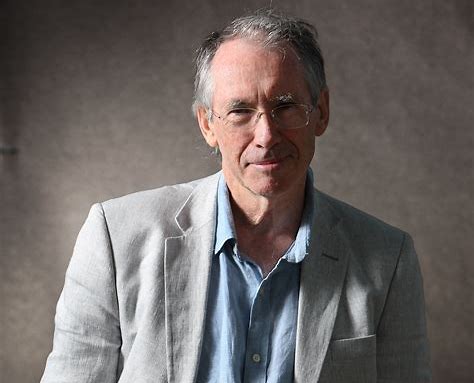
Ian McEwan
Miranda, as it turns out, has secrets of her own, secrets that she can’t hide from someone like Adam who never sleeps and spends all of his spare time researching and learning about the world into which he has so suddenly been thrust. And after Adam warns Charlie that Miranda is not really who she seems to be, things begin to get tricky – especially after Adam declares his own love for Miranda.

Machines Like Me explores whether or not artificial intelligence can ever understand human emotions, motivations, and reasoning. Will it be possible for such a created consciousness to grow beyond the black and white rules it has initially been designed to follow? And if not, how will the inevitable conflict be resolved? What is to be done when our synthetic humans decide that they know what’s good for us better than we do. Which of us crosses the line first?

This quote (page 370 of the Large Print edition) should give all of us, researchers included, something to think about: “They couldn’t understand us, because we couldn’t understand ourselves. Their learning programs couldn’t accommodate us. If we didn’t know our own minds, how could we design theirs and expect them to be happy alongside us?”

Bottom Line: Machines Like Me is a bit frustrating at times because of the long, detailed digressions that McEwan strays into that do not always do much to advance the “discussion” of the potential conflict between artificial intelligence and human intelligence - but the patient reader will be well rewarded for his patience. I suppose that Machines Like Me will be most easily appreciated by science fiction and alternate reality fans, but it is a thought provoking philosophical novel as well.

Tuesday, September 17, 2019

There's Still Something in the Water

I wonder what everyone is looking at.

I got to chatting with the guy working the Target book section this afternoon about all the similar book covers I've been noticing and was surprised at how quickly he agreed. Well, after I told him that I had posted a few pictures of the books last week, he got this great idea to display them together. As I was leaving the store, I saw him begin the process of moving all the tags so that they would match the new Mystery & Suspense display he had created. 

And there are more like this...many, many more.

(Click on the image for a larger version.)