Monday, January 08, 2024

What I'm Reading This Week (January 8, 2024)

 I've eased into my reading plan for 2024 by finishing up two review copies I didn't finish reading last week (Family Family and The Night of the Storm) along with another review copy (My Favorite Scar) that I will be thinking about for a long time. I can't wait to tell you all about that last one later this week.

In the meantime, I've started several new books while keeping in mind some of my set reading goals for the year. The result is that I'm rotating between eight books at the moment as the mood strikes me that it's time to switch books as one or another of them start to feel a little stale or tedious. Two of the "new books" (The Diabolical and The Blues Brothers) are actually review copy carry-ins from last year that are to be published in February and March, respectively. And as usual, my additions to what I'm reading don't exactly match last week's expected adds:

I'm a fan of David Putnam's Bruno Johnson series but have really been bad about reading them out of order, and that's not the best way to read this particular series. Anyway, The Diabolical is the latest, and finds Bruno, his wife Marie, and the fourteen children in their care hiding out in Costa Rica because there are criminal warrants out on both Bruno and Marie in the U.S. The kids, if you're wondering, with the exception of one of them, are rescues from terrible Los Angeles home environments. No paperwork required...

As you can see from the cover, All the Little Bird-Hearts is part of the 2023 Booker Prize longlist. It is one of the four remaining books I want to read from last year's list, and it is fascinating for a couple of reasons: it's main character and narrator is an autistic woman trying to cope with the new friend she has suddenly acquired from next door; and the author Viktoria Lloyd-Barlow is herself autistic. I'm only fifty pages in, but I already find myself enjoying the prose and the plot so much that I'm finding it hard to put this one down.

I've not read a lot of John Grisham recently, I suppose because I started finding his books to be a little repetitive in nature, but since The Boys from Biloxi is one of the books loaned to me by my brother last summer, I decided to see why he liked it so much. Grisham strikes me as kind of an old-school storyteller of multi-generational crime sagas - a style that builds to the real action very slowly over many pages (454 in this case) and that's what's happening here. So far, so good, and it reminds me that this style can be a comfort read.

I found a ratty copy of Francine Prose's 2018 What to Read and Why at a used-book bookstore a couple of years ago and until recently have done little more than thumb through it. But having read the novel about Mary Shelley and Frankenstein a few days ago, I was interested in learning more and it's all covered in chapter 2, so I started reading more carefully. And I still am. The book selections are not too surprising, but Prose has a lot to say about them and she says it all very concisely and clearly. This will take a while.

It's shameful to admit that I had never heard the name Walter Tevis before stumbling upon his wonderful The Queen's Gambit last year, but it's true. I was so fascinated by that novel and the Netflix series it resulted in that Tevis became someone I wanted to know more about. Turns out he was even bigger in his day than I imagined, and I've finally started reading The Hustler, a novel about pool hustlers that became a major motion picture during Hollywood's golden years.

I'm about to finish up Thomas H. Cook's Red Leaves and I'm chipping away at Writing to Learn, so I may have time to begin one or two from this bunch later in the week:


As I said up above, I'm easing in to the new plan, especially by searching for back catalogue books that I either entirely missed back in the day or just never got around to reading. Have a great reading week, guys, and don't forget to tell us all about it!

Sunday, January 07, 2024

Family Family - Laurie Frankel


Even in high school, India Allwood knew that she would be a great stage actor one day. So what if she couldn't sing, not all Broadway hit shows are musicals, are they? And India was certain that nothing could - or should - keep her from achieving her dream, not even giving birth to a baby girl during her senior year. So after helping to choose an adoptive mother for her daughter, it was off to New York to attend the prestigious Lenox University School of Dramatic Arts where history repeated itself. This time just before graduation India gave birth to a son for whom she picked out what she believed would be wonderful parents for him.

In the present day, India Allwood is a TV superstar with two adopted children of her own and a hit TV series that gives her the opportunity to star in a movie about a subject dear to her: adoption. India believes that too many books, movies, and TV shows portray adoptions as tragedies for all involved, and having experienced it herself now from both sides of the adoption equation, she wants to change the narrative by making a movie with a more positive message about the  experience. Unfortunately, India admits out loud one day to an interviewer that the movie itself is not really very good. And now she is receiving criticism not only from studio executives afraid that she has killed the movie's prospects, but from some who want to hear a stronger pro-choice message from her and others who want to hear a stronger pro-life message. India is learning quickly that is impossible to appease those on both sides of that argument at the same time.

It surely cannot get more complicated than that. Oh, but it does.

First Rebecca, India's 16-year-old biological daughter decides to come to India's rescue via a TikTok video that immediately goes viral. Then her adopted twins, Fig and Jack (especially Fig who loves the idea of having an older sister), team up with Rebecca to enlist India's biological son, Lewis, to the cause. Well, you get the idea. Suddenly, India has more support than she can handle: her four children, Rebecca's adoptive mother, Lewis's two adoptive fathers, Rebecca's biological father, and Lewis's biological father. Keeping up?

No longer does being cancelled from her chosen career seem to be the most important thing in India's world. She and her bunch are about to figure out that you don't have to share blood to be family, that you don't have to be family family in order to be part of a family.

Unfortunately, this very worthy message seems a little heavy-handed at times, and even my favorite characters never quite seem real. Because of its quirky characters Family Family reads more like comedy than drama, and somehow that serves to  lessen the impact of the book's message about the infinite number of ways that a family can be formed. This is one of those books I wanted to like a lot more than I ended up liking it. Rating: 3 Stars

Laurie Frankel jacket photo

Friday, January 05, 2024

The Last Talk with Lola Faye - Thomas H. Cook


Harvard educated historian Lucas Page has come to St. Louis to promote his latest book in front of a small group of "museum regulars," none of whom, as it turns out, have any interest in actually taking a copy of the book home with them. Just when he's ready to call it a night, Lucas is approached at his table by what he at first assumes is a homeless woman. But then he realizes that he is looking into the eyes of Lola Faye Gilroy, the very woman he still blames for his father's murder two decades earlier. 

"She'd come to make her case before me, clarify the issue  Woody Gilroy had raised in his suicide note, rid herself of the guilt he'd laid at her feet, revisit all that in a talk with me, then enter her plea at the end of it: not guilty."

Or had she?

 Feeling a little as if he'd been tricked into it, Lucas finds himself agreeing to have a drink with Lola Faye so that they can have a talk about their lives in the aftermath of what happened all those years ago. Lucas, under the impression that Lola Faye is still the uneducated and naive small-town Alabama girl she was when his father hired her to clerk in the family variety store, figures that their conversation will be a short one. Just a quick drink, a little polite conversation, and Lola Faye will be out of his life again - exactly where she belongs.

But then Lola Faye starts asking questions, good ones. And those questions cause Lucas to rethink everything he was so certain that he knew about the night his father was shot to death in his own kitchen by someone lurking outside in the dark. Long before Lucas realizes it, Lola Faye has taken over the conversation and she's guiding it exactly where she wants it to end up. 

"The last best hope of life is that at some point during living it, all that you did wrong will suddenly teach you to do right."

The Last Talk with Lola Faye is an intense novel, one in which the pressure is turned up so gradually that the reader ends up being lulled into the same false sense of complacency that Lucas experiences. As it became clearer and clearer that Lucas is correct in feeling threatened by where Lola Faye is leading the conversation, I couldn't turn pages fast enough. Even so, the book's ending is a completely satisfying one that I never saw coming. And that's a good thing.

This is my first experience with a Thomas H. Cook novel, and that strikes me as remarkable considering how much crime fiction I've read over the last several decades and that Cook has written something like three dozen novels. But that's kind of nice, really, because now I have Cook's huge back catalog to explore, including Red Leaves, the one I started a couple of days ago.

Thomas H. Cook jacket photo

(Special thanks to Kathy and her Reading Matters blog where she turned me on to Thomas H. Cook novels via her review of The Last Talk with Lola Faye.

Thursday, January 04, 2024

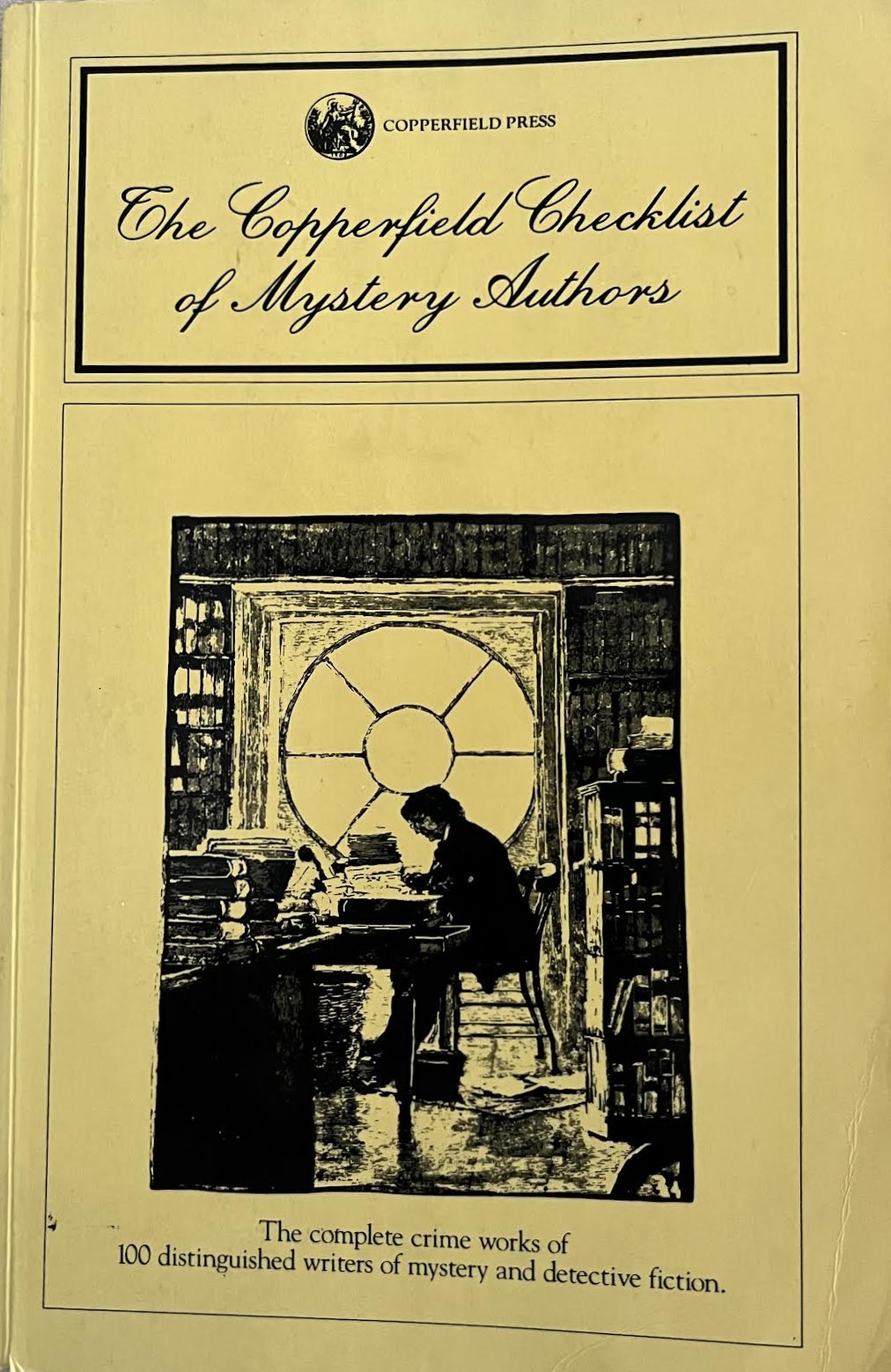
The Copperfield Checklist of Mystery Authors


Considering the number of times my books have been packed, moved, culled, and been lost or destroyed by movers since 1987, I have no idea how this little checklist of mystery writers has survived for the last thirty-five years or so. The main thing it has going for it in that department, I suppose, is that it is so slim and lightweight that I can always find a place to tuck it away - and forget about it for another few years.  

Anyway, this morning I decided to thumb through it again, and got to wondering about some of the mysterious authors on the checklist that I've never read. Keep in mind that even in 1987 many of these authors were already considered pioneers in the mystery genre, and most had extensive back catalogues to explore. 

QUESTION: Are you very familiar with any of these names, and which would you recommend as a place to begin exploring the list? 

  • Catherine Aird (1930-  )
  • Margaret Allingham (1904-1966)
  • Charlotte Armstrong (1905-1969)
  • Josephine Bell (1897-1987)
  • Anthony Berkeley (1893-1970)
  • Earl Derr Biggers (1884-1933)
  • Nicholas Blake (1904-1972)
  • Christianna Brand (1907-1988)
  • John Buchan (1875-1940)
  • W.R. Burnett (1889-1982)
  • Gwendoline Butler (1926-2013)
  • Leslie Charteris (1907-1993)
  • Elizabeth Daly (1878-1967)
  • Dorothy Salisbury Davis (1916-2014)
  • Mignon G. Eberhart (1899-1996)
  • Nicolas Freeling (1927-2003)
  • R. Austin Freeman (1862-1943)
  • Andrew Garve (1908-2001)
  • Jonathan Gash (1933-  )
  • Cyril Hare (1900-1958)
  • H.R.F. Keating (1926-2011)
  • Richard and Frances Lockridge (1898-1982) (1896-1963)
  • Philip MacDonald (1899-1961)
  • John Rhode (1884-1965)
  • Arthur V. Upfield (1888-1964)
  • Henry Wade (1887-1969)
  • Sara Woods (1922-1985)
These represent about half the checklists/bibliographies in the book. I'm in pretty good shape when it comes to having read the other, generally better known, writers in the book, but I draw a blank on the ones listed. I suppose the good news is that a lot of their work must be in the public domain by now and available on Project Gutenberg for downloading. 

Where should I begin? Any thoughts?

Wednesday, January 03, 2024

Lessons in Chemistry - Bonnie Garmus


You have to read this book. 

Imagine a feminist comedy that you can't really take half-seriously because the characters are at times too stereotypically perfect to be believable, or a novel in which a dog is smarter than most of the humans in the story - and is definitely a better communicator than most of them. Then there are a little girl who is reading Faulkner as a five-year-old and her brilliant chemist of a mother who develops an afternoon TV cooking show that ends up convincing women across America that they have every right to hold a job outside the home (these are the late 1950s, so that's kind of a revolutionary thought). And there's the little girl's genius father who just may be the unluckiest man in the country when it comes to walking dogs. And there's a lady from across the street who offers to help care for the little girl mainly just to get away from her jerk of a husband a few hours a day. 

Now imagine that this is a story that manages to combine tragedy with comedy so effortlessly that you are often surprised to find yourself laughing at what surely have to be inappropriate moments...really, aren't they? Imagine, too, that you are going to walk away from this novel with a pretty decent understanding of what everyday life felt like for women both at home and in the workplace in the 1950s. And that you are going to conclude that the women who helped changed all of that deserve a whole lot more credit than they get. 

"Cooking is chemistry. And chemistry is life. Your ability to change everything - including yourself - starts here."

Now you've pretty accurately imagined what reading Lessons in Chemistry was like for me. So is this a fairytale, a fable, or a serious novel disguised as a comedy and a farce?

You have to read this book.

Bonnie Garmus (color version) jacket photo

Monday, January 01, 2024

What I'm Reading This Week (January 1, 2024)

 I didn't plan it this way, but how appropriate it seems to be starting a new reading week on the very first day of 2024. Last week I finished The Last Talk with Lola Faye by Thomas H. Cook and Lessons in Chemistry by Bonnie Garmus and I will post reviews for both books in the next several days (loved them). I'm also close enough to finishing two others, The Night of the Storm by Nishita Parekh and Laurie Frankel's Family Family that I'll probably finish one of those today.

I'm a fan of Laurie Frankel novels, so I was happy to get hold of a review copy of Family Family (to be published on January 23). You might think it's missing a comma in its title, but the first "Family" is actually an adjective and the second a noun. Put a little emphasis on the adjective, and you get the point of the title. This is Frankel's take on today's debate about pro-choice vs. pro-life and where adoption fits into the debate. It also addresses cancel culture issues - and is a very good coming-of-age novel for several different characters.

Nishita Parekh's debut novel, The Night of the Storm, is set in Houston during the horrific arrival of Hurricane Harvey in August 2017. The storm killed about 100 people mainly because of the catastrophic flooding involved. But inside one home, they are not nearly as worried about the wind and water outside as they are about the neighbor who seems to have been mysteriously murdered right before their eyes.  That's scary. But even scarier is knowing that the killer has to be a family member trapped inside the house with the rest of them.

I'll also be spending some time this week with some of these:

I enjoyed Thomas H. Cook's The Last Talk with Lola Faye so much that I immediately went looking for another Cook novel and found Red Leaves (2006). The plot doesn't sound very original (a couple's teenaged son is accused of kidnapping and killing a little girl and they start to believe he may really have done it) but I don't know if that was true seventeen years ago, so I'm giving Cook the benefit of the doubt. Cook is a good storyteller, but this one reads very differently from The Last Talk with Lola Faye...not nearly as suspenseful so far.

This will be my first nonfiction read of 2024 even though it's not turning out to be quite the book I thought it was going to be. The basic premise of the book is that the act of writing forces you to focus your mind and organize  your thoughts to such an extent that writing about it is the best way to learn any new subject you take on. It's commonly called "reading across the curriculum" and means that every discipline should include teachers capable of teaching how to write within their specific area. I'm hoping that it helps me in my own writing of reviews, especially of nonfiction titles.

My Favorite Scar is to be published on January 16, so it will definitely be coming up very soon for some serious reading time. I've read the first two chapters (18 pages), and I'm enjoying the style even though this is a translation from the Spanish. If you're wondering what the "favorite scar" thing is all about, it refers to the two main characters, a father and his fifteen-year-old daughter. In one conversation between the two, the father tells Ambar that she is his favorite scar as he points to a tattoo of her name on his forearm. I'm looking forward to this one.

Also waiting in the wings for now are these:


Believe it or not, I've never read a novel by Agatha Christie or Lilian Jackson Braun. That's the kind of hole in my reading that convinced me to shake things up in 2024. I'm curious to see if I'll be able to avoid slipping back into the same old choice-habits, though. 

Have a great reading week everyone...hope you didn't wake up with a headache this morning! Happy New Year!