Wednesday, May 15, 2019

Where'd You Go, Bernadette - Finally a Movie

I read a review copy of Where'd You Go, Bernadette? back in 2012 (can't believe it's been almost seven years) and I've been hearing speculation about a movie version for what seems like forever.  Well it looks as if the movie is finally going to be released in August and will star Cate Blanchette, Laurence Fishburne, and Billy Crudup, among others.  I'm a bit surprised that the official movie trailer reveals so much detail about the plot, but I have to admit that it looks really good.  Honestly, I'm just thankful that studios are still making movies for adults; I suppose that all those computer-generated comic book things are subsidizing what I consider to be the good stuff.


In case you are interested in reading the book before its movie version is released in August, I'm re-posting my September 2012 review below to help you make up your mind as to whether or not this one is for you.

======================================================


No one in Seattle really knows much about Bernadette Fox.  And that it is precisely why the other mothers at her daughter's prestigious private-school love to gossip about her so much.  Oh, they know that her husband is one of the stars on the Microsoft campus, and they all like her bright fourteen-year-old daughter, Bee, just fine.  But Bernadette has committed the cardinal sin among the private-school mother set: she refuses to "volunteer" for any of the little jobs that take up so much of their time.  

Bernadette does not even pretend that she wants to be involved.  Not only does she not speak to them in the school drop-off zone, she doesn't even notice when she runs over the foot of one mother insisting to speak with her.  Something is wrong with this woman; they are sure of it, and they are going to make her pay for it.

Elgie knows that something is going on with Bernadette but his top secret project for Microsoft, and the huge amount of money he brings home for managing it, allow him to ignore the problem - or, at least, postpone dealing with it.  Things do seem to be going well enough, after all.  Bernadette is managing the home front efficiently (although with help he knows nothing about), and Bee is doing so well in her studies that she has qualified to claim her promised reward: a family trip to Antarctica.  

Then all hell breaks lose, Bernadette disappears, and, after a while, Bee seems to be the only one still looking for her.  

Believe it or not, serious as all of this sounds, Where'd You Go, Bernadette is the funniest novel I have read this year.  The book, a satirical look at the whole Microsoft/Seattle lifestyle, is filled with laugh-out-loud moments that will have the reader wondering just who the "crazies" in the story really are.  But, although it sometimes borders on slapstick, the novel does offer some touching reminders and insights into the relationship between mothers and daughters.  It will be young Bee, after all, who refuses to give up the search for her missing mother - even when others are certain that she is lost forever - and the precocious teen is determined to go to the ends of the earth to find her.  

Among the memorable "little moments" in the novel, is the scene in which Bee discovers the wonder of Abbey Road, the 1969 Beatles album that was to be the last the band ever recorded.  Bee's shock and embarrassment when her mother sings along with every one of the songs - in perfect sync with the recorded vocals - is a smile-inducing reminder that children find it impossible to believe their parents were ever young enough to be "cool."  Even Bee, a girl who considers her mom to be her best friend, cannot quite make that leap.

Adding to the fun, Where'd You Go, Bernadette is very cleverly structured to tell its story largely via a series of email messages, handwritten notes, transcripts of conversations, and the like.  This places the reader inside the heads of a variety of characters who reveal more about themselves than they want to reveal - probably even to themselves.  This one is hard to put down.
===============================================

And as a bonus, here's the video that first caught my attention:

Tuesday, May 14, 2019

Battle of the Brazos - T. G. Webb

I have been a college football fan for a long time, and an admirer of Texas A&M University for just as long.  Admittedly I was not alive in 1926, but imagine my surprise to learn that Texas A&M and Baylor played a game in October 1926 during which at halftime an A&M student was struck so hard on the head while on the field of play by either a club or a chair that he died of his injuries the next morning.  Why had I not ever heard of this?  Well, as it turns out, it might be because both schools decided within days of the tragedy that it might be best to pretend that it never happened.  In 2018, some 92 years after the tragedy, T.G. Webb and Texas A&M University Press published Battle on the Brazos, an in-depth attempt to determine exactly who struck and killed Charlie Sessums.

Battle on the Brazos is about as well-researched as can be expected in a case where those directly involved are long dead, including the two young men most likely to have killed Sessums.  The two were themselves dead within just a few years of Charlie Sessums - one to pneumonia and the other to a fatal collision with a firetruck.  Hubert and Edwin Connally were cousins, but more importantly they were also related to the mayor of Waco, Texas, home to Baylor University and this football game.  Let the coverup begin.

Battle on the Brazos is not a long book, but Webb packs a lot of information into the book's three parts: Part I, The Rivalry; Part II, The Riot; and Part III, The Murder.  College football was still in its early days (especially in Texas) when the A&M-Baylor rivalry began, and for near a decade their matchup was considered to be the premier football game in the state.  For a time the two schools respected each other both on and off the field, but that began to change during the 1922 and 1924 games, so what happened in 1926 was not a real surprise to anyone who had been paying attention (the schools did not play each other in 1923 or 1925).

And what happened on the field at halftime of that 1926 match was a full-fledged riot during which students from both sides were determined to defend the "honor" of their schools at any cost, thus sullying the very honor they were supposedly defending. The A&M students seem to have been both outnumbered and, if accounts from the day are to be believed, outgunned.  Witnesses at the time swore that Baylor students brought in wooden clubs along with the team's athletic gear that day - something, however, that has never been verified.

Bottom Line: Battle on the Brazos will especially interest football fans, true crime fans, and those interested in Texas history. It is written in a readable but rather dry style that builds a strong case that the killer has at last been identified.  There is little doubt that if the Waco police department and the presidents of both universities had put this much effort into finding out what really happened on the field that day, the killer would have been identified in 1926.


Book Number 3,392

Monday, May 13, 2019

Book Finds: One Hundred Best Novels Condensed

All my life, I've haven't been able to resist picking up old books I stumble across because you just never know what you might come across.  After all, they were published for a reason and a specific intended audience, and you might be part of that intended audience even years and years later.  One Hundred Best Novels Condensed: Four Volumes Combined into One, edited by Edwin A. Grozier is one of my latest snags - for all of fifty cents - and it was meant to be.


 The book is over 500 pages long and includes three-to-five-page summaries of what were considered to be some of the "one hundred best novels" in 1931 when the book was printed. I see, though, that Best Novels was first printed in 1919 (in four separate volumes?), so maybe it's the best choices as of 1919.  Either way, most of the titles will be familiar to anyone fairly well versed in the classics, although there are a few that I have absolutely never heard of.  The plot summaries were written by three different men (Grozier himself, Charles E.L. Wingate, and Charles H. Lincoln) and the style differences are fairly obvious.  Some of the summaries are actual recaps in the voice of one of the three men and others are done more in the voices of the original authors, including direct quotes from the originals (I definitely prefer the latter style).  Each summary also includes a one-page biography of the book's author, so there is a lot of information packed into these faded green covers.

The reason I like this little book so much is that the plot summaries are exactly what I need sometimes to remind me of the intricacies of the plot lines of books I may have read decades earlier; these days I can barely remember the details of the books I read last month.  The fact that it's also a quick way to choose something from the past that I still haven't read is just an added bonus (not to mention that it also allows me to pretend to myself that I actually read something I know I'll never get around to reading).  This one will be receiving some more wear and tear in the coming years.

Sunday, May 12, 2019

It's Sunday, So This Must Be Barnes & Noble


In what has become my most typical Sunday of the last nine years, I paid a visit to a local Barnes & Noble bookstore this morning before heading over to my father's apartment for a visit.  Dad turned 97 at the end of April and he's still going so strong that I can easily see this being my routine for a few more years.  And that makes me happy.


At the B&N, I stopped at the first display of new books that I came to, right near the door and checkout area. I was almost immediately drawn into a conversation that was starting between a customer and the woman behind the counter because I sensed a book question on the horizon; I play that kind of book trivia game with myself when the opportunity offers itself because it's always funs to match wits with a bookstore employee.  

The question went something like this,"What's the name of that classic children's book about a bunch of kids who got tattooed and then mistreated each other?  You know, it's a classic that we all had to read in high school."  As the clerk stared blankly at her, I knew that it seemed suspiciously familiar to me and that I ought to know the answer to the question.  But it wouldn't come to me.  I couldn't, though, resist asking if that was the one where all the kids were stranded on an island, but I still couldn't conjure up the title.  Then it started to click, and I blurted out "something of the Flies?" And the customer immediately said, "Lord of the Flies" with a huge smile on her face.  The clerk could only add that she had never heard of it - and since she appeared to be in her mid-thirties I can only assume that her high school didn't require students to read that one.  But is Lord of the Flies no longer considered a classic of its type?  Come on.

But the strangest thing of all is that after I continued down the aisle and stopped at a table down the way, what was in the center of the display other than The Lord of the Flies?  I picked it up and waved it at the customer - and sold her a copy on the spot for her granddaughter.  (B&N offered me neither a commission nor a job, by the way - and this is the same B&N that refused to offer me a job when I retired for the first time a few years ago even though I proved to know more about books and the floor plan of this specific location than the interviewer knew.)

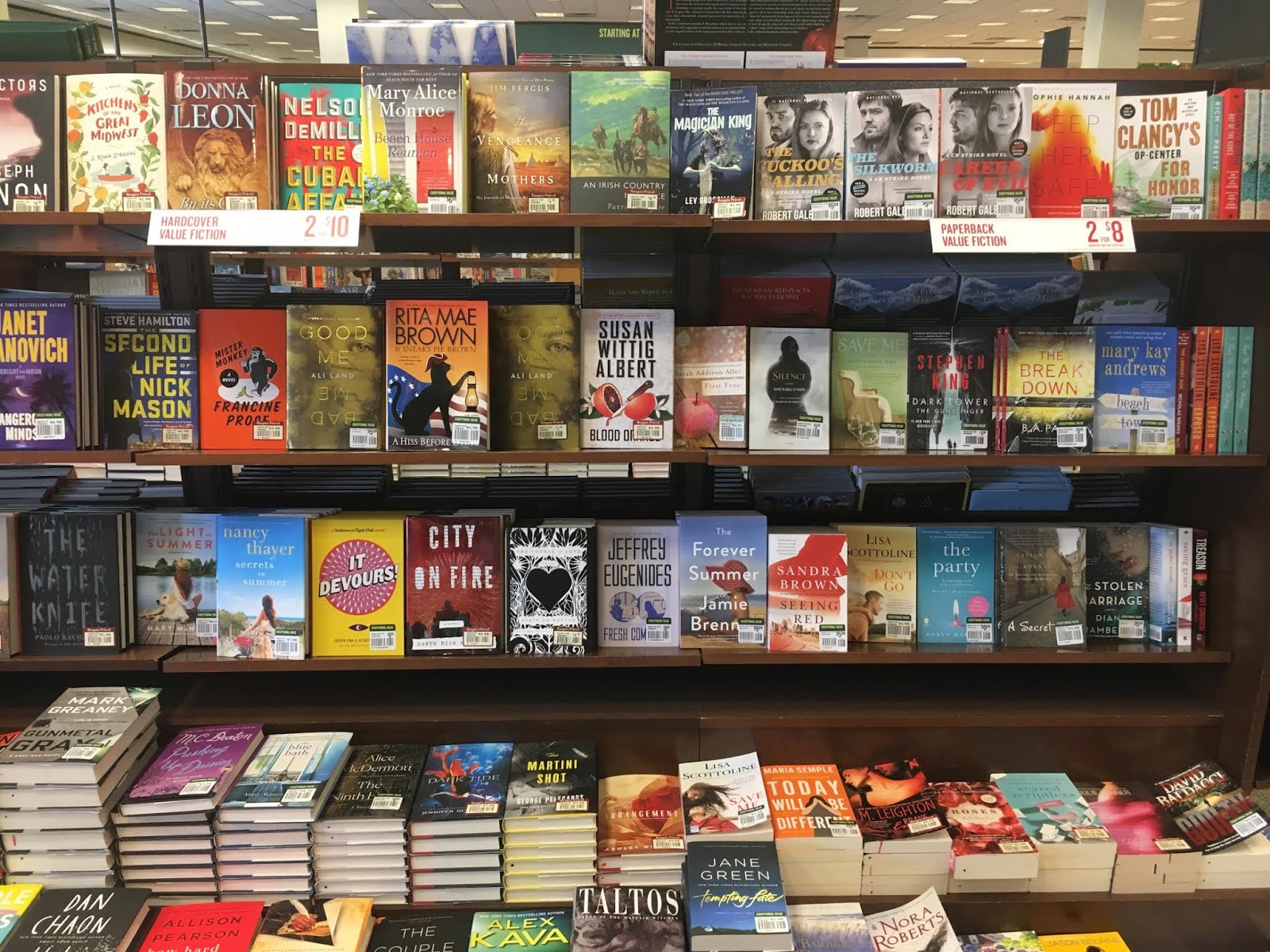
I left the store with two new magazines (Mystery Scene and the 100th issue of Bookmarks) and no books.  That's mostly because I simply don't have room to bring in many more books anymore, so I limit myself to new books from favorite authors and the occasional one I just can't resist.  I was really tempted by the display pictured above though because they had several books by authors I've enjoyed in the past on sale for five to seven dollars a piece.  Turns out that I have more willpower than I thought I had.

Happy Mothers Day, ladies!  I hope you are all having a great day.  My wife is hunkered down with one of those Hallmark movies that she loves so much, so we are both having a nice afternoon.

Saturday, May 11, 2019

White - Bret Easton Ellis

There was a time, back in the day, when I simply refused to give up on a book - if I started it, I finished it before I dared start another. Those days are long gone. Now if a book doesn't seem worth the effort within my having read 50-75 pages of it, it's a goner and I move on to the next one.  In fact, White by Bret Easton Ellis is already the eighth book I've abandoned in 2019.

I learned of White through a television interview of the author that focused on the cultural observations contained in the memoir.  It was made to seem as if the book was primarily a critique of the oversensitive world we all live in nowadays, a world in which reputations and images can be trashed with the single slip of a tongue or wrong opinion posted to Facebook or Twitter. I really wanted to read what Ellis had to say about this because he made so much sense during that interview. 

But as it turns out, the book is much the typical memoir of a man who finds that his interesting life and lifestyle is more behind him than in front of him.  And honestly, I'm just not very interested in the drug-driven partying lifestyle that Bret Easton Ellis has lived. Nor have I ever been able to make it through his best known novels Less Than Zero and American Psycho, so I don't have the patience to search for the pages in the memoir that do interest me, observations like these:


"This anger was new, something I'd never experienced before - and it was tied in with an anxiousness, an oppression I felt whenever I ventured online, a sense that I was going to somehow make a mistake instead of simply offering an opinion or make a joke or criticize someone for something.  This idea would have been unthinkable ten years earlier - that an opinion could become something wrong - but in an infuriated, polarized society people were blocked because of these opinions, and unfollowed because they were perceived in ways that might be inaccurate.  The fearful began to instantly see the entire humanity of an individual in a cheeky, offensive tweet and were outraged; people were attacked and unfriended for backing the 'wrong' candidate or having the 'wrong' opinion or for simply stating the 'wrong' belief. It was as if no one could differentiate between a living person and a string of worlds hastily typed out on a black sapphire screen."
[...]
"...this anger could become addictive to the point where I just gave up and sat there exhausted, mute with stress.  But ultimately silence and submission were what the machine wanted."
 [...]

"But most of us now lead lives on social media that are more performance based than we ever could have imagined even a decade ago, and thanks to this burgeoning cult of likability, in a sense, we've all become actors. We've had to rethink the means with which to express our feelings and thoughts and ideas and opinions in the void created by a corporate culture that is forever trying to silence us by sucking up everything human and contradictory and real with its assigned rule book on how to behave.  We seem to have entered precariously into a kind of totalitarianism that actually abhors free speech and punishes people for revealing their true selves." 
As I skim the rest of the book, I see that Ellis expresses his disillusionment and disgust with the approach taken by those on the left who so proudly label themselves the Resistance. He considers their whole approach to life to be both childlike and embarrassing even to the point that he cannot take any of it seriously.  Coming from a man like Bret Easton Ellis, someone who has lived and voted the liberal side of politics for his entire life, this is an almost shocking admission.  

The man does not mince words:
"Whenever I heard certain people losing their shit about Trump my first reaction was always, You need to be sedated, you need to see a shrink, you need to stop letting the 'bad man' help you in the process of victimizing your whole life.  Why would they do that to themselves?"
Ellis ends White with a couple of sentences that capture the state of mind he described in that television interview, life after his outspokenness has cost him friends and false friends galore:
"Or maybe when you're roiling in childish rage, the first thing you lose is judgement, and then comes common sense.  And finally you lose your mind and along with that, your freedom." 
Scary thought, that.

Bottom Line: Bret Easton Ellis has a lot to say about our sharply divided country and world, but if you are as uninterested in his books and movies as I am, you may struggle to last long enough to find those comments. But this one is most definitely worth a hard look whether or not you agree with the man's opinions or his lifestyle.  You may find that you love it for the reasons I don't like it, and hate it for the reasons I like it. Who knows?

Friday, May 10, 2019

Favorite Novels: News of the World - Paulette Jiles

I met Paulette Jiles at the San Antonio Book Festival in 2016 where I heard her speak about her upcoming new novel, News of the World. From the beginning, the premise of the novel intrigued me, and when I found out that it was all based on real life Texas characters, I knew I had to read it. It was only when I went to buy a copy from Paulette that I realized that the book was not yet for sale. After a few minutes of conversation about the book and history of that part of our state, Paulette graciously offered me a review copy of the book, and it has been one of my favorite novels ever since.  

I said it in July 2016 when I wrote the review shown below: News of the World is a beautiful novel, and it deserves to find a huge audience.  I re-read the book a few weeks ago, and I feel more strongly than ever about that...but let Paulette herself make the case that this is a very special novel.


========================================================================
What could possibly be more intriguing a main character in a book about Reconstruction Era Texas than a seventy-year-old retired Army captain who makes his living as a traveling “professional reader”?  Perhaps a ten-year-old little girl who has spent the last four years of her life as a captive of the band of Kiowa who butchered her parents and little sister in front of her might just do it.  And then if you have these two characters cross paths, as Paulette Jiles does in News of the World, you have the makings of what is certain to be one of the most memorable novels of 2016. 

People in north Texas are hungry for news, and they will pay to hear it.  Captain Jefferson Kyle Kidd is only too happy to bring it to them as he travels from town to town reading articles aloud from the latest East Coast newspapers he can get hold of – all for the price of one thin dime per listener.  It is, in fact, the kind of solitary existence that Captain Kidd much prefers at this stage of his life.  But that all changes one trip through Wichita Falls when Kidd reluctantly agrees to transport a little girl back to the aunt and uncle she has not seen since being captured by the Kiowa.  The 400-mile trip from Wichita Falls to near San Antonio will prove to be a dangerous one, one that will forever bind the old man and the little girl together.

Paulette Jiles
There is plenty of old fashioned western action in News of the World: threatening Indians, shootouts with bad guys who want to steal the little girl for their own purposes, rising waters and dangerous river crossings, big-hearted women of the evening, etc., and all of it is well handled by Jiles.  But what makes the novel special is the relationship that develops between Captain Kidd and young Johanna as they steadily make their way southward.  Johanna has forgotten everything about her life before the Kiowa took her.  No longer does she speak English or German; she has forgotten how to use a knife and a fork; and she considers the idea of wearing a cloth dress to be a ludicrous one.  She is now, and in her mind forever will be, a Kiowa Indian.  White men – and women – terrify her, and she wants nothing to do with them.

But Johanna senses something in Captain Kidd that calms her, a level of trust that moves her to call him “grandfather” in her own language.  Soon, though, their relationship has gone way beyond merely honoring the Captain with a title, and Johanna begins thinking of Kidd as her grandfather in the truest sense of the word.  And perhaps surprising even himself, Kidd grows so fond of the little girl that he would willingly give his own life to save hers.


News of the World is a beautiful novel, and it deserves to find a huge audience.

(Review Copy provided by Publisher)