Monday, August 09, 2010

The White Garden

Everyone knows that, one day in 1941, famed British author Virginia Woolf filled her coat pockets with heavy rocks before stepping into the cold waters of the river Ouse. Perhaps because of the extra weight she carried into the water with her, Woolf’s body would not be found until three weeks later. Woolf’s family and friends, aware that she was often in a suicidal frame-of-mind, were not surprised by her end, so the official verdict of suicide was never challenged. Now, in an intriguing piece of alternate history, The White Garden, Stephanie Barron examines the possibilities of what may have happened during the three weeks between Woolf’s disappearance and the recovery of her body in the Ouse.

American Jo Bellamy has come to Kent’s Sissinghurst Castle to copy the layout of its famous White Garden for a wealthy client who wants to replicate it on the grounds of his Long Island home. Imogen Cantwell, the castle’s head gardener, has grudgingly agreed to allow Jo full access to the White Garden so that she can gather all the measurements and photos she will need to create a perfect copy of the grounds for her client. But, for Jo, this is not just a way to generate revenue for her business; it is an opportunity to visit the part of England in which her beloved grandfather, who killed himself just three weeks earlier, lived for the first two decades of his life.

After Jo discovers that her grandfather spent several months as an apprentice gardener at Sissinghurst (the home of Woolf’s lover, Vita Sackville-West), her search for garden records from that period leads her to the discovery of what appears to be a partial diary written in the hand of Virginia Woolf herself. Oddly, however, the journal is bound with a note indicating that, when it was boxed for storage, it actually belonged to Jo’s grandfather. Even odder, the first entry in Woolf’s handwriting is dated the day after her supposed drowning in the river Ouse.

Already puzzled by her grandfather’s so out-of-character suicide, Jo now starts to wonder if her trip to Sissinghurst might have everything to do with the timing of his death. Her quest to have the first half of the journal authenticated, and to find its missing pages, draws the attention of others wanting to exploit the astounding journal for their own purposes. For Jo, it is all about understanding why her grandfather felt it necessary to end his life; others want a piece of the fame, and profit, which will result from proximity to a journal that might literally rewrite a significant portion of literary history.

The White Garden works because of the way Barron mixes her intriguing plot of alternate history with a large cast of interesting characters. Admittedly, some of the characters are a little too close to stereotypes to be completely effective but, in the context of the story, even those characters contribute to the fun. Fans of Virginia Woolf, and Anglophiles of all stripes, are likely to enjoy this one a great deal. I certainly did.

Rated at: 5.0

Sunday, August 08, 2010

Who Will Turn Out the Lights in America's Last Bookstore

First there were locally owned, independent bookstores; then came the first of the big box bookstores to steal their market share and force the locals to close their doors by the thousands.  Next came the even-bigger box bookstores to knock off those earlier indie-killers - and we said goodbye to Crown Books and B. Dalton, and learned to live with the colorless, watered-down version of Walden Books.

Suddenly Barnes & Noble and Borders seemed to share the national book market except for the surprise of something called a Books-A-Million store that popped up every once in a while.  Mass market book consumers rejoiced at the low price of bestsellers, while hardcore book lovers grieved at the way the book market was being controlled by just two giant corporations.  Prices were down, but so was choice.

Then along came a little internet startup, Amazaon.com, to challenge the dominance of the Big 2 book retailers.  Barnes & Noble and Borders, used to having things their way, and not immediately recognizing the challenge of competing with an online bookseller the likes of Amazon, were slow to react.  So slow, in fact, that Borders has been losing money and closing stores for years in a desperate struggle just to keep its own doors open.  And now, even Barnes & Noble, the company that once seemed headed toward total dominance of the market, has put itself up for sale because it is not likely to otherwise survive into the next decade.

But even Amazon should not get complacent because, with the increasing acceptance of e-books, even a giant like Amazon is going to be challenged for market share.  Barnes & Noble did just that with the introduction of its Nook e-book reader but does not seem to have regained much, if any, market share in the process.  Sony tried it, probably with even less success than Barnes & Noble (just a gut feel on my part because I do not have the numbers to verify it).  But hold on, Amazon, because here comes Mr. Apple, Steve Jobs, with his iPad, a not-so-little gizmo that can function pretty well as an e-book reader among the countless other things it can do that the Kindle cannot.  Mr. Apple is, in fact, so powerful that he has already, much to Amazon's chagrin, changed the whole pricing structure for e-books.

My question is this: what are you going to do when bookstores go the way of CD stores?  Remember those things?  I, for one, did not even realize they were disappearing until they were almost all gone, but I am a bit more aware of what is happening this time around.

Someone please tell me this means a return, at least, to the days of the local independent bookstores, a step back toward the way we were a few decades ago.  I am willing to pay higher prices (and do it all the time) if it means that I can still drive to a nice bookstore on Saturday mornings, especially to one that still feels like a real bookstore.  Alas, Sven Birkets of the Wall Street Journal does not believe this will be the case.  See this article, "Bye-Bye Bookstores," for his thoughts.

Thankfully, I already own a pretty good library of my own and a room into which I can escape to be surrounded by books.  Perhaps that is where we are heading - a return to the fantastic home libraries of centuries past.  These days, I find myself singing the old song, "Stop the World and Let Me Off," with a whole new appreciation for its sentiments.

Saturday, August 07, 2010

Two Great New Books Leave Me Feeling a Bit Guilty

There are only two novelists whose work I always buy just about as soon as it is published in hardcover: James Lee Burke and Elizabeth George. Not so coincidentally, both are still adding to a long series featuring a detective who has seen great change over the years. In the case of Burke, of course, I'm referring to Dave Robicheaux and, in the case of George, to Thomas Lynley. I have way too many years, and reading hours, invested in these characters not to care what happens to them next. It's been a bit painful to be a Thomas Lynley fan during George's last couple of books, but I'm told that he's back in fine form in This Body of Death. James Lee Burke has to be one of the finest novelists writing today, a distinction he has held for many years now, and I always look forward to the next Dave Robicheaux adventure.

I finally got around to buying both This Body of Death and Burke's new one, The Glass Rainbow, this morning. Normally, I would have grabbed each of them within days of their hitting the bookstores, but things have been so frantic around here since March that my bookstore visits have been limited - and, even during my few visits, I always forgot to look for the books.

Today I made a special trip to Barnes & Noble to see if I could afford to take both of them home with me. And it appears that my slow purchase paid off. The Elizabeth George book had a 50% off sticker on it and the James Lee Burke book has hit the bestseller list, meaning that it carries a 30% discount. Add my B&N membership discount to the scenario and I ended up getting 60% off on the George book and 40% off on the Burke one. Cover price on the two books totals $58.98 but I ended up getting both for a grand total of $28.63, plus tax.

So now I feel guilty for stiffing my area indie bookstores. But times are tough, my indie friends, and I simply could not resist this deal because, when I left the house this morning, I feared I was going to have to make the near impossible decision of choosing between the new Burke and the new George. I do promise to keep buying as much from you indie guys as possible, especially when it comes to new authors and backlists. Forgive me?

Friday, August 06, 2010

Camden Threatens to Close All City Libraries in 2011

It looks like Vice-President Biden's "Summer of Recovery" tour is fast turning into the bust the rest of us already knew was headed our way like a bat out of hell.  Sometimes, it seems, our beloved leaders are the last too know (scary as that thought is).

That's not the case, though, for the bunch in charge of Camden, NJ, government.  They know how bad it really is out there, and they are chopping non-esential services to help control their budget shortfall.  You know, non-essential services like public libraries.   According to the MyFox, New York, website this is what is going to happen:
New Jersey's most impoverished city will close all three branches of its public library at year's end unless a rescue can be pulled off.

Camden's library board says the libraries won't be able to afford to stay open past Dec. 31 because of budget cuts from the city government. The city had its subsidy from the state cut.

The library board president says the library system, which opened in 1904, is preparing to donate, sell or destroy its collections, including 187,000 books.

Board president Martin McKernan says keeping the books around would pose a fire hazard.
I am desperately hoping that this library board president is just playing a game of "chicken" with those in charge of funding the Camden library system because I cannot imagine that a library president would ever really resort to destroying a collection of this size.  Why would the books be more of a fire hazard if the doors are locked on Camden's libraries than they are now?  Does this guy really expect that his future budget will some day go up to a level that allows him to replace 187,000 books all at once?  Or is he a prime example of the Peter Principle...a man who has been promoted one too many times and is now in a job that demands way more competence than he possesses?

Libraries continue to take the hit for all the foolish government overspending in other areas.  This disgusting trend seems to be on the rise - and that is very, very wrong.

Thursday, August 05, 2010

Blog Design Changes - Good, Bad, or Ugly?

I've been bored with my blog template for months now, but I can't seem to find anything close to what I'd like to change it to.  Blogger offers endless combinations within their new templates but I'm disappointed to find that none of the new templates take full advantage of the width of the display.  There just seems to be too much wasted space on the edges of the presentation - but then I don't claim to have an artistic bone in my body, so maybe it's just me that sees it that way.

Anyway, I'm going to try something similar to what you see at the moment, with a little more fooling around with the details and lineup along the sidebar yet to come.  I do like that the posts seem easier to read with this layout, and that's the main thing because staring at a computer screen all day long is already hard enough on the eyes. Regardless of where I end up with all this tinkering, the old look seems gone forever because I managed to overwrite it early on and it now seems to be an irretrievable thing of the past.

Please tell me what you think of the new look.  I know it's a drastic change, so let me know whether or not it works for you, and if it is any easier to read on your particular display.

Wednesday, August 04, 2010

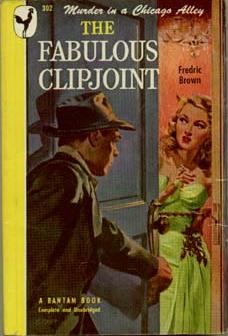
The Fabulous Clipjoint

The Fabulous Clipjoint is one of those books I would have missed out on if not for the relative ease with which copyright-expired (and, usually, out-of-print) books can be downloaded from the internet these days. Frankly, prior to discovering this title on the net, I knew nothing about Fredric Brown’s writing career or about The Fabulous Clipjoint, his first novel. What caught my eye was the cover art of the book’s original 1947 edition – one glance, and I knew I had to read this one.

From the cover, I expected a hardboiled piece of American noir style detective fiction, the kind of stuff that is still so popular with readers today. And I got that, plus a big surprise. The Fabulous Clipjoint is also a fine coming-of-age novel about Ed Hunter, an 18-year-old boy whose father is murdered late one night in one of Chicago’s back alleys. The elder Hunter, apparently on his way home from an evening of local bar-hopping, never made it. Ed was not particularly happy about his home life even before his father’s murder but, now that he is stuck at home with just his alcoholic stepmother and his randy 15-year-old stepsister, life at home is trickier than ever.

Things get interesting when Ed’s Uncle Am (Ambrose) shows up to help the family through its grieving process. Am runs a game of chance in a traveling carnival that just happens to be passing through Chicago at the time of his brother’s murder. Am is determined to identify the killer and, since Ed’s boss has given him a few days off from the printing shop he works at, he decides to help his uncle nose around Chicago’s north side.

Am knows that his amateur investigation will bring him and Ed into contact with the thugs and lowlifes that thrive in Chicago’s criminal underbelly. If they are to achieve their goal – and survive the process – the Hunters are going to have to be as tough and fearless as those they want to intimidate into telling them the truth about what happened to Ed’s father in that dark alley. Am, world-wise and rough enough around the edges to pull off a tough guy image, begins a makeover of young Ed that is half the fun of the book. Before long, Ed, dressed in his new tough-guy-suit, finds himself bluffing his way through confrontations with thugs and their women in a way he could not have imagined himself doing even a few days earlier.

This one is fun on several different levels, among them: its hardboiled look at big city life just after WWII; the nurturing relationship that develops between Ed and Am; the ease with which Ed grows into playing “gangster;” and the feeling of nostalgia that reading something from this period always generates.

The Fabulous Clipjoint won an Edgar for “Best First Novel” in 1948 and, as it turns outs, was the beginning of a series of seven “Ed and Am Hunter” novels written between 1947 and 1963. In addition to the Ed and Am series, Brown wrote at least twenty other novels in the fifties and early sixties, most of them science fiction. He is also the author of numerous short stories. I look forward to experiencing more of his work – in both genres.

Rated at: 4.0