Monday, October 31, 2022

Thinking Out Loud: The Graduate


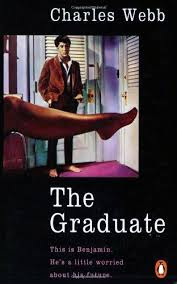
 Most movie fans are familiar with The Graduate, the movie that I suppose made Dustin Hoffman into the major star he is/was. I saw it in the theater when it was first released and remember being taken with it, but until now I had not read the 1963 novel by Charles Webb that is the basis of that film.

To the best of my recollection, the movie pretty closely follows the plot of Webb's novel, but my impression of the main characters as portrayed in the novel is very different from the one I got from the movie. The movie version of "Ben" came across to me as a still-innocent and somewhat naive recent college graduate who never stands a chance against the older woman who seduces him. "Elaine," the older woman's daughter came across in the film version as an impetuous young woman who finally recognized the spark that existed between her and Ben. Because I was just a little bit younger than the two characters, I found it easy to identify with them and enjoy the premise of the movie.

But the novel strikes me completely differently. I find "Ben" to be an almost-dangerous sociopath in the book, and "Elaine" a fool who can be easily swayed on major life decisions by whatever the last person she speaks to about them thinks. The two are a terrible mix, and between them they manage to harm numerous side characters along the way, including their own parents. Oddly enough, I remember rooting for Ben during the entire movie - but rooted for Mr. & Mrs. Robinson during most of the novel. Mrs. Robinson was clearly the instigator in all that followed, but she did her best to control the dumpster fire she created. Ben, on the other hand, was a walking can of gasoline.

Webb's writing is very conversational and does a great job of illustrating just how deeply psychotic Ben is, and how passive Elaine is. It's an easy read, if you're interested - and now I'm curious enough to watch the movie again to see if I react to it the same way. 

Saturday, October 29, 2022

Thinking Out Loud: Our Country Friends


Our Country Friends is my second experience with a Gary Shteyngart novel, and I suppose the good news is that I actually finished this one. So needless to say, I won't be recommending this one to others without including a lot of qualifying comments:

What drew my interest to Our Country Friends is that it is one of the first novels I've encountered set in 2020 and focusing on all the confusion of that year as the world tried to figure out how to cope with a new virus that eventually came to be called COVID-19. In this case, a handful of lifelong friends and friends-of-friends gather in upper New York state where they hope to keep themselves safe by self-quarantining there as a group during the worst of it. What they fail to take into account is just how closed in a little world they are creating for themselves. It is no surprise to the reader that little cracks in past relationships soon widen into major breaks. Within weeks, new sexual pairings have come and gone, petty jealousies have been exposed, and none of the friends will ever see each other the same again.

I've come to the conclusion that a Gary Shteyngart novel is unlikely to work for me because I find it so difficult to be around his characters long enough to finish one of them. The core characters in this one are mainly first-generation Americans whose parents are from either Russia or India (Shteyngart himself came to America from Russia as a seven-year-old). Even though I am always curious about the immigrant experience, Shteyngart's characters are so obsessed by their experiences that it makes them seem weak and superficial - and even worse, boring. The only character that kept me at all entertained was the little Korean girl who had been adopted by the host couple. She is a gem of a character.

Gary Shteyngart is a definite darling of the critics (especially those on the East Coast), so I must be missing something. I just wish I could figure out what that is. 

Monday, October 24, 2022

Thinking Out Loud: One for the Blackbird, One for the Crow


According to Olivia Hawker, One for the Blackbird, One for the Crow came to her very easily. Once she gathered up various elements of her own family history, the plot and the characters fell right into place, and even the actual writing was not that much of a chore. She still says that this 2019 novel is the "easiest" one she has ever written.

I don't know about all of that, but I can tell you that I was almost immediately taken by the setting (two 1876 Wyoming homesteads) and the tragedy/crime that bound two families so close together whether they wanted to be bound that tightly or not. After the two families find themselves both lacking an adult male as winter approaches, they have little choice but to move in together and share what they have. Any other decision will likely result in the deaths of several children and most of the livestock owned by the families.

Really, the Bemises and the Webbers were bound together long before the two women put aside their rage and pride long enough to consider what was best for the children. Ernest Bemis made certain of that when he shot and killed Substance Webber after catching the man and Cora Bemis in a more-than-compromising position. Ernest almost immediately rode the 20 miles into town to turn himself in to the sheriff, and after his trial was sentenced to two years in jail. Suddenly the women are dependent on the seventeen-year-old Clyde Webber and the sixteen-year-old Beulah Bemis to do all of the farm labor their husbands had previously done if either family were to survive the approaching winter.

One for the Blackbird, One for the Crow is a well written piece of historical fiction, one that gives a clear picture of how precarious life was in that part of the American West in 1876. It features two strong women trying to do what's best for their own families despite what has so recently torn both families apart. It is part western, part love story, and part character study. I give this one four out of five stars.


(I'm reading at a slower pace these days, and I'm finding that slowing myself down has made me look at novels in a slightly different way. I'm catching more details and nuances now, I think, than I have for a while - and I'm enjoying that.)

Wednesday, October 12, 2022

Fight Night: Thinking Out Loud


 I'm stretched a little thinly these days, but even though this won't be anything like a formal review, I want to "think out loud" a little about a book that I recently enjoyed a whole lot, Fight Night by Miriam Toews. 

The novel is about three generations of very unique women living under the same roof. The grandmother is elderly and not doing very well physically; the mother is pregnant and own her own since her husband walked out on the family; and the nine-year-old granddaughter is pretty much a little genius even though she's currently expelled from school.

For me, what made this book so special is the total bonding between the little girl and her grandmother. The fun comes from the fact that each of them believes she is the guardian and almost-sole caretaker of the other. There's a lot of watchfulness and education going in both directions, and much of it is laugh-out-loud funny - when it's not putting a tear in your eye.

Even the unborn child (called "Gord" by the family due to how big the mother is in her late term pregnancy) becomes a minor character that the little girl speaks to in her head and watches out for. 

That's it. If this little bit of info appeals to you, you really need to get your hands on this one. It's the one book that keeps popping back into my head so far from this year's reading. 

Tuesday, October 11, 2022

In Which I Get Interviewed on The Big Show

 My life has been marked by two constants over the decades: a love of books and reading, and an appreciation for roots music. I define roots music as that made by the pioneers and first generation singers of a particular genre, be that country music, bluegrass music, the blues, rock and roll, etc. But because music genres can evolve so rapidly over the years - even to the point of becoming mere shadows of the original sound - I've always had a tendency to hold on to the old stuff when I find it. And after 60 years of collecting, that means I have a music library that includes 78s, 45s, LPs, 8-track tapes, cassette tapes, CDs, DVDs, and self-recorded video and audio performances along with thousands of digital recordings. 

That's the other side of my life that has occasionally bled over to my posts here at Book Chase. I try to keep that to a minimum, but sometimes I can't help myself. This is one of those times.

I recently sat down with Andy Gallo and Jim Sloan as a guest on their music-related podcast called "The Big Show" to talk about my lifetime love for music of this sort and my meager efforts to help keep the music alive over the years. We get into things like what sparked my regard for the music, the internet radio station I helped run for several years, and all the video recordings I still make and share on the internet.

I finally got the courage to listen to it myself, and I hope one or two of you might find it interesting since I've been neglecting Book Chase so badly. It explains where a lot of my energy is going these days.


Wednesday, August 31, 2022

August Reading: Quantity Was There, Quality Not So Much


While I did manage to read 11 books during August, a good part of my reading seemed to go more sluggishly than usual. I'm not sure if I simply made some poor choices this month or if it's more a problem with my general attitude. Whichever it was, I'm really looking forward to a fresh start in September...although that's the peak of hurricane season in this part of the country, so it could turn out to be an extra-interesting month. Looking at the ones I finished in August, I'm a bit surprised to see that six are novels and five are nonfiction because I don't usually read nonfiction in that kind of ratio to fiction.

  1. The Good Daughters - Joyce Maynard - Two very different families share a huge secret for over 50 years
  2. We Came, We Saw, We Left - Charles Wheelan - man travels around the world for 9 months with wife & 3 teens - Nonfiction
  3. To Hell with Honor - Larry Sklenar - Brilliant explanation of what happened at The Little Big Horn and who was responsible
  4. Stupid Things I Won't Do When I Get Old - Steven Petrow - writer vows to practice what he learned from watching his parents age
  5. The Woman in the Library - Sulari Gentill - Disappointing mystery using novel-inside-a-novel structure that is stupefyingly formulaic 
  6. Real Tigers - Mick Herron - #4 in the terrific Slough House series 
  7. A String of Beads - Thomas Perry - Jane Whitefield #8 - Jane hides he childhood Seneca best friend from cops and killers 
  8. Bridge of Spies - Giles Whittell - Account of U-2 pilot Gary Powers, his capture by Russia and exchange for Russian spy
  9. Blood Safari - Deon Meyer - Second novel in Meyer's Lemmer series about a South African bodyguard
  10. In a Dry Season - Peter Robinson - Inspector Banks #10 - a case going back to World War II; Banks meets DS Annie Cabbot
  11. Packing My Library - Alberto Manguel - Argentinian author's 10 essays and 10 "digressions" on packing away his personal library
I think I'm a little disappointed with this lot because even some of my favorite crime writers didn't impress me all that much this month. I read four of my favorites this month: Mick Herron, Deon Meyer, Thomas Perry, and Peter Robinson. Of the four books of theirs, the only one that stands out to me as representative of their best work is Herron's Real Tigers, and based on that one's not-so-promising plot summary I was surprised by how much I liked it. I absolutely loved the first third of Meyer's Blood Safari, but it became a routine thriller after one of the book's two main characters was sent to hospital in a coma - where she stayed for almost the rest of the book. I "liked" Perry's A String of Beads right up until I realized that Jane Whitefield was going to be using the same evasion techniques that she uses in all of the novels featuring her and that she was simply teaching them to a new client. This is only the second Whitefield novel I've read, though, so maybe that criticism is premature. As for Robinson's 10th Inspector Banks novel, it is built around one of the things I like least in fiction: an author "telling" what happened rather than "showing it." In In a Dry Season, Robinson flashes back and forth via an unpublished manuscript that fills in most of the holes from the WWII portion of the novel. And that goes on for about ninety percent of the novel. It became tedious because the "manuscript author" wrote so passionlessly.

And then there were two 2-star books this month: the robotically written The Woman in the Library and the way-over-my-head Packing My Library. I had high hopes for the latter, even to purchasing an e-book copy of it, but it was a real slog for me, and I'm still not sure what I read...or why. The Woman in the Library is so formulaic that it could have been written by a software program. Before that one is over, just about every main character in the novel has been featured in the role of red herring. It just got silly sometimes.

My favorite book of the month turned out to be To Hell with Honor by Larry Sklenar, an in-depth study of exactly what must have happened at the Little Big Horn in 1876 when Custer and most of his 7th Calvary were destroyed. It is very well researched and explains how such a thing could have happened - along with whom was really responsible for the poor decisions made that day by the US Army leadership. It is a real eye-opener, and it's earned a permanent slot on my History bookshelf.

Now that I've come to the end of this month's reading recap, I realize just how "blah" a reading month I really had. Having had only one particularly outstanding book all month long means that September almost has to be better without even trying very hard. 

As August ends, I'm at various stages of reading: Wuthering Heights by Emily Brontë, The Burgler (a 1954 noir novel by David Goodis, Isaac's Storm (Erik Larson's third book), The Three-Cornered War (a Civil War history by Megan Kate Nelson), and Leave the Grave Green by Deborah Crombie. Already, these seem to be going better than almost everything I finished it August.

Bye for now.