Monday, January 11, 2021

Dead Land - Sara Paretsky

Because I hadn’t read one of Sara Paretsky’s V.I. Warshawski novels since 2009’s Hardball, I wondered how much I would remember about Vic and all her supporting characters. A decade away from exposure to Warshawski’s Chicago is, after all, plenty long enough time to forget most of the details of that world, even as vividly as Paretsky always presents them. As it turns out, I needn’t have worried because before I knew it, Dead Land fit like an old glove and I was totally immersed in Paretsky’s story. Dead Land even marks kind of a milestone in the Warshawski saga because it is the twentieth novel of the series.


This time around, Warshawski finds herself doing battle with some powerful, and very rich, people who understand exactly how to manipulate Chicago’s corrupt political system in their favor. For these people, it’s all about making millions of dollars by exploiting public property on Chicago’s Southside lakefront - and if they bribe a few of Chicago’s finest politicians along the way, they can make it happen. That’s bad enough, but it all gets personal when Vic’s Canadian goddaughter stumbles into a situation that might expose their scam before it happens. Those same rich and powerful folk can’t let that happen, so people begin to die, and it is only a matter of time before they come for Vic and her goddaughter. 


That’s the main plot, but I enjoyed the side plot even more. It seems that Bernie Fouchard, the goddaughter in question, has found a famous protest singer living in squaller on Chicago’s streets. The woman is mentally unstable and in danger of dying from exposure. Lydia Zamir, the singer, watched her husband shot to death on stage and never recovered from the shock. She eventually disappeared and no one realized where she was until Bernie and her friends spotted her in her street-nest playing a tiny toy piano and singing songs to herself. Now, Bernie wants to protect the woman - but she and her boyfriend are bringing way too much attention to this part of Chicago to suit the criminals who want to exploit the area. 


Bottom Line: Sara Paretsky writes a complicated novel and, at times, I did struggle to keep up with all the threads and names she was exploring. But the struggle is worth the effort because Dead Land ends in a very satisfying manner with all the loose ends tied together - and Paretsky does that without having to use the book’s last pages to have one character annoyingly explain to another character everything that’s just happened as so many mystery/crime writers seem to do today. If you are wondering, Dead Land will also, I think, work as a fine standalone novel for those unfamiliar with the Warshawski timeline and character. Now I wonder why I stayed away for so long.


Sara Paretsky (book jacket photo)

Friday, January 08, 2021

Dark Passage - David Goodis


David Goodis’s 1946 novel Dark Passage could not possibly be more aptly named than it is because this is one of the darkest novels imaginable. According to the Library of America, Dark Passage is the novel that gave Goodis the little bit of fame that he enjoyed during his lifetime, and that was primarily because the book was turned into a popular movie starring Humphrey Bogart and Lauren Bacall. Other than that relatively brief moment, it appears that his work was kept alive  mostly by what LOA calls an “international cult following” which included several prominent European film directors who adapted Goodis’s work for the screen. 


The story begins with Vincent Parry escaping San Quinton Prison where he has been jailed for the murder of his wife. Parry, though, is one of those rarities among a prison population that never stops protesting its innocence - he really is innocent. He did not kill his wife, and he was convicted of the crime almost entirely based upon the trial testimony of a friend of his wife’s. Now, recognizing the perfect set of circumstances that have come together, Parry makes his escape and heads for San Francisco where he hopes to hide out long enough to figure his next step.


Parry’s luck bizarrely continues long enough for him to reach the city. And that’s where his real problems begin.


With Vincent Parry, David Goodis created one of the most paranoid characters imaginable, a man who cannot afford to be wrong about any of the people he encounters in the city while he tries to figure out how to disappear forever. He is paranoid, but he is justifiably paranoid, and Goodis places the reader inside the man’s head for pages at a time, eerily allowing readers to experience that feeing of paranoia for themselves. We literally hear, word-by-word, what is going on inside Vincent Parry’s head as he faces one critical situation after another.


Dark Passage is not a long novel, coming in at around 200 pages depending on which edition you read, but it paints a picture of 1940s San Francisco that is hard to forget. This is a city where life is lived in the shadows and after dark, a place where every one (including the cops) seems to have angle, a place where nothing is exactly as it seems and no stranger should be trusted. It is a city whose underbelly is not confined to only a few blocks, and as Parry moves through it, searching for a safe way out, things begin to happen to him. People die, people fall in love or think they fall in love, and several of them expose the blackness of their own hearts to the world. 


Bottom Line: Dark Passage shows clearly why David Goodis has come to be known as somewhat of a pioneer of American noir novels. His distinctive style, and his feel for troubled characters and city streets, make his writing stand out even in a genre filled with more famous writers. The Library of America volume of five novels, in which this is the first entry, also includes: Nightfall (1947), The Burglar (1953), The Moon in the Gutter (1953), and Street of No Return (1954). 


David Goodis

Tuesday, January 05, 2021

Pretty Little Children - Sophie Hannah


Seldom does a book keep me reading all the way through to the end despite the frustration I feel the entire time I am turning its pages. Sophie Hannah’s Pretty Little Children just achieved that rarity - and I still feel frustrated. So let me tell you why.


First, the book’s hook is based entirely on a single sentence that is even prominently displayed on its cover: “Twelve years have passed…so why don’t Thomas and Emily look a day older?” The sentence is expanded upon inside the book jacket, too, with only a little more character background provided to entice potential readers. I’m not much of a fan of fantasy or horror novels, but because Perfect Little Children got nice coverage in one of the year-end issues of the New York Times Book Review as one of 2020’s better novels, I thought I’d give it a chance. 


To her credit, Sophie Hannah’s writing style makes for a relatively easy reading experience, so before I knew it, I was fifty or sixty pages into the novel. If I am going to abandon a book, this is the point at which I would normally do it, but I was no closer to the truth about the kids, and I was well and truly hooked by its essential question. I knew that if I abandoned it, I would wonder for weeks what the answer to the riddle on the cover was, so I read on…and on, and on without getting much closer to an answer. And that is my second complaint about Perfect Little Children. Nothing much happens, and when something does happen, it moves the reader only a minute distance toward any answers about what is going on with Thomas and Emily. All the while, Beth, the book’s main character is struggling to make anyone take her seriously, even most members of her immediate family. And then everything ends in one of those big-reveal confessionals in the book’s last couple of short chapters. I admit that the book’s ending is a clever one, but by that point I was so frustrated with its pacing, that I still wish I had never started Perfect Little Children. 


Bottom Line: So little happens that it is almost impossible to share any of the plot without risking an inadvertent reveal or two in the process, so I won’t even try to do that. Perfect Little Children is billed by its publisher as an “expertly plotted tale of psychological suspense.” Let’s just say that it plods along much too slowly to generate all that much suspense.

Monday, January 04, 2021

Four Days into the New Year and Here They Come

 Four days into the new year, and I'm already stacking up new books at an impossible reading-pace. They are coming from several different directions, but the primary culprit has been my local library branch (the Harris County, Texas, public library system is wonderful). 

I came into January already having several library books on hand from December, but I picked up three new ones this morning. Thankfully I was able to extend the check-out time on all three of them to six weeks:

This one comes highly recommended by a blogger whose opinion I trust, so I expect to enjoy it. It's set in 1964 Texas, a time period and a place I remember well for having experienced them for myself.


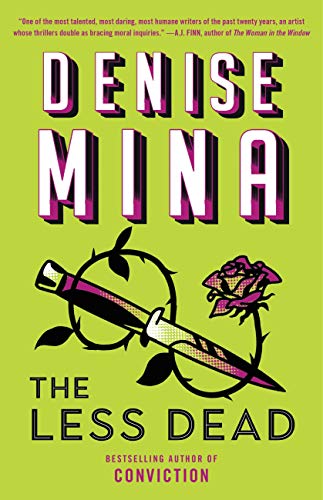
I've been a fan of Denise Mina for years, but haven't read anything new from her for a while. As part of my new year's cleanup, I replaced my digital subscription to the New York Times Book Review with a full-access digital subscription to the U.K.'s Times and Sunday Times newspaper. I trust the paper's book section to be more complete and inclusive than what I've been getting from the New York Times for the last couple of years, and I remember it fondly from my London years. And that decision directly led me to this Denise Mina book. 


This one came in quicker than I expected it, so I'm going to have to work it into the schedule. I'm a Jo Nesbø fan, but this thing is a doorstop, coming in at 550 pages. I've read the first several pages, though, and it appears to be a fairly quick read.


I've also purchased one tree-book:


This one is officially called "Mickey Haller Book Six," but because the Harry Bosch character is on hand to work with his half-brother in this new Haller book, I couldn't resist it when I found it for a good price at a local retailer.

And then, there are the two free e-books that Prime gave me yesterday: 


I knew nothing about either of these before they showed up on the Amazon Prime First Reads list, but both show some promise. I'm familiar with Rice's books and like them, and the Hadley & Grace novel is said to be sort of a Thelma & Louise situation. Now, the problem is going to be finding the time to read them.

So there you have it: four days and six new books in my life already. Along with that subscription to the Times and Sunday Times, that means I need to start turning some pages.

Saturday, January 02, 2021

The Black Echo - Michael Connelly

I didn’t plan it this way, but I do find it rather appropriate that my first book review of the new year is of the book that introduced one of the most popular fictional detectives in recent memory to the world. The Black Echo, published in 1992, was the first of Michael Connelly’s “Bosch novels.” Now, depending on how you count them - and it does get a little bit tricky - there are at least 26 novels featuring Harry Bosch. Most recently, Bosch has been teamed up with a new, younger partner called Renée Ballard, but beginning in 2008, Bosch has also been paired with his famous half-brother in four of the “Lincoln Lawyer” novels. In fact, just this morning I stopped by a Target store to purchase a copy of last November’s The Law of Innocence, the latest Lincoln Lawyer novel in which the brothers join forces. 


Interestingly, Hieronymous Bosch is already forty years old when readers first meet him. Harry even lives alone in the same stilted-house in Los Angeles that readers have come to know so well over the last almost-thirty years. But most tellingly, he is already in trouble with his police superiors, a state of being that will become the norm for Harry in many, if not most, of the next two-dozen books. Too, many of the characters that will become mainstays in later books are first introduced - although not always in a positive way - in The Black Echo. 


It is in this first book that readers learn enough of his backstory to understand why Harry is so ready to fight the system and why he is such a loner and a rebel. The experiences that Bosch had as a tunnel rat during the war in Vietnam play a crucial role in The Black Echo, but readers also learn enough here about the detective’s mother and his boyhood to understand why he still carries such deep emotional scars.


The Black Echo begins when Bosch gets called to work a possible crime scene at Lake Hollywood where a dead body has been discovered inside a large drainage pipe. It is likely that the dead body belongs to an addict who has suffered an overdose, but cause of death will need to be determined before that can be confirmed. After Bosch has had time to study the scene and the body for a few minutes, he realizes two things: the death is probably not accidental and he knows the victim, a fellow Vietnam War tunnel rat - someone Harry  helped into rehab a couple of years earlier but had not spoken with since. 


That’s when things start to get complicated and Harry begins to realize that there is more to this case than some very powerful people want to see exposed. Harry Bosch, though, is not a man who can easily be stopped from carrying an investigation through, no matter where that investigation may lead him or who tries to shut him up. He continues working the case, picking and choosing what information he will share with others involved in the investigation, despite the two Internal Affairs cops who trail him all the while in hopes that they can finally claim his badge as a trophy. Harry is just not a real popular guy with the LAPD or the FBI.


Bottom Line: The Black Echo is an excellent introduction to Harry Bosch and the Los Angeles police department environment he must survive if he wants to do his job. I can tell you from experience that you do not necessarily have to read this first book in the series before jumping into the series at some later point, but it will certainly help you understand the character if you do. This is particularly true for the Vietnam-based portion of Bosch’s backstory. The Black Echo is an impressive debut novel. Even more impressive is the way that Michael Connelly has lived up to all the promise shown in the novel. 


Michael Connelly book photo

Friday, January 01, 2021

True Crime for 2021


I make no secret of how big a fan I am of books published by The Library of America. The books are always of the highest quality, and especially considering the uniqueness of their compilations, they are always interesting in addition to being a bargain. So what better way to begin a new year than to highlight one of the last two LOA books I purchased in 2020, True Crime: An American Anthology.

Like a lot of people, I've been fascinated by true crime books for a long time. For me, it probably started way back with the publication of Truman Capote's In Cold Blood, but I always thought of the genre as being something that only grew popular  around the time of that groundbreaking book. Obviously, I've been very wrong about that assumption.

This compilation is almost 800 pages long, and it includes the "true crime" writing of authors like Cotton Mather, Benjamin Franklin, Nathanial Hawthorne, Abraham Lincoln, Ambrose Bierce, Mark Twain, Damon Runyon, H.L. Mencken, Theodore Dreiser, Edna Ferber, and James Thurber. Others included in the anthology are not so surprising, names like: Jack Webb, Dominick Dunne, Ann Rule, James Ellroy, Gay Talese, and Capote himself.

This one arrived in December, so I'm looking forward to dipping in and out of it a good bit during 2021. Most people, I think, believe that the Library of America only publishes the classics that established the publisher's reputation. That is far from the case because Library of America books include collections of science fiction classics, war reporting, baseball and other sports writing, classic detective fiction, etc. I add ten or twelve of their books to my shelves every year and now have 114 of them. If you don't know this publisher, do take a look at their catalog because I think they will surprise you.