Tuesday, December 08, 2020

I Jonathan: A Charleston Tale of the Rebellion - George WB Scott


I’ve been a fan of Civil War historical fiction since I first learned about the bloodiest war in American history as a child more than sixty years ago. Of course, as a true “son of the South,” while watching a movie or reading a book about that war back then, I always rooted for the men in gray despite knowing what the ultimate outcome really had been. Over the years, my interest in the war grew more along the lines of battle strategies and the generals on both sides, and I began to take a deeper interest in the biographies and histories. As it turns out, I had great-great grandfathers on both sides, one a private in a Louisiana infantry unit, the other a sergeant in a Texas calvary unit that fought for the Union. My Texas relative was, in fact, one of less than 800 Texans who fought on that side of the line. It was only later that I developed an interest in diaries of the time and learned about what the war was really like for those Southerners who watched everything around them being destroyed little by little until it was all gone. What they endured was incredible. 


George Scott’s I Jonathan: A Charleston Tale of the Rebellion is very much akin to reading one of those old diaries. The difference is that the “diary” at the heart of I Jonathan is a fictional one supposedly recounted in 1941 to a young man by his 100-year-old great uncle. Needless to say, time is of the essence, and the nephew repeatedly visits his uncle in the old man’s nursing home so that he can capture his story before it is too late. As Ralph Bennett tells us, his uncle was in and around Charleston, South Carolina, for the entire war, having arrived there from Europe shortly before the first shots were fired at nearby Fort Sumpter. 


The odd thing about Jonathan being in South Carolina at all during the Civil War is that he is not a Southerner. Rather, he is a Bostonian who accidentally finds himself landing in Charleston as he is returning to the U.S. from an extended stay in Europe. Unfortunately for Johnathan, upon arrival his personal circumstances continue to worsen even to the point that he cannot afford to make his way back to Boston any time soon even if he wants to - and because his heart has been broken by the one he left behind there, he doesn’t want to. So, not entirely by choice, Johnathan finds himself stranded in South Carolina at the most awkward (and dangerous) time for someone from Boston to be stuck in that city.


For the next four years, Jonathan has to find a way to survive. All the while trying to make a place for himself in a world that is being ripped apart around him, he has to avoid those who cannot understand why a healthy young man like him is not already part of the Confederate Army. He manages to avoid taking up arms by contributing to the cause in a way that allows him to do so without totally feeling that he has betrayed his own country: he transports goods for a local trader, he becomes part of a local fire brigade, and for a short time, he is even a blockade runner. 


Bottom Line: The beauty of I Jonathan is in the evolution of the way its main character sees the fatal mistake that the South has made. While he can never reconcile the idea that professed Christians are willing to die in order to keep other men in bondage, he begins to understand why everything is happening as it is, and in the process, he learns to admire many of the men and women he comes to know. Through Jonathan’s friendships with slaves, free blacks, plantation-owning families, military men, and traders, the reader gets a sense of what it may have been like in one of the South’s major cities and ports as the war progressed. If you are interested in historical fiction of this period, do take a look at the haunting  I Jonathan. 


George WB Scott

Review copy provided by publisher or author

Monday, December 07, 2020

Library Loot & a Slight Change of Plans

Well, that didn't take long at all.

I mentioned last week in my December reading-plan post the likelihood that plans would change when my library notified me that some of the books I've had on hold are ready for pick-up. And that happened over the weekend, so this morning I picked up three of the books (they never come one-at-a-time) I've been waiting for. 

Luckily, I was able to extend the check-out time on two of the three books to six weeks, but I can hold onto the other one for only two weeks because others are in line waiting for their chance to read it. And, as it turns out from my closer look at the book, The National Road: Dispatches from a Changing America is really something I want to read. In fact, I read the the author's introduction as soon as I got it home. 


Tom Zoellner appears to be a veteran of road trips and hikes that have covered ground all over America. Some of the essays and experiences he writes about here go back thirty years; others are relatively fresh. The intent of the book is to take a look at how America has changed in recent years as the economy changes, politics become disruptive, and the pandemic keeps us largely at home and off the road. Zoellner teaches at Chapman University and Dartmouth College, and he has written for major newspapers and magazines. I doubt I have much politically in common with him, but I'm curious to get his take - all the while hoping he shows a good bit of empathy - on what he finds in middle America, especially in the small towns and rural communities he encounters. We'll see. 


I'm almost afraid to read this one. I am intrigued by the plot summary, and the book got high praise in the New York Times Book Review last week, but I didn't realize until a few minutes ago that it is book number 31 in a series that Archer Mayor began in the late eighties. Just what I need...another long detective series to work my way through. But here's the premise: a 28-year-old man has just died of a brain injury he suffered in childhood. If that's not bad enough, his brother, and only caretaker, has gone missing at the same time. Now it's up to Vermont Bureau of Investigation cold-case investigator Joe Gunther to figure it all out. Was the childhood injury accidental or something more sinister, etc.? I have this one potentially in-hand all the way to January 19, 2021 (doesn't that seem like a long time away?), so I don't have to decide for a while. Are any of you guys familiar with the Joe Gunther series? If so, what do you think of it? Is it even advisable to jump into a series this late without knowing some of the main character's backstory?

And then there's Ken Bruen's A Galway Epiphany. This is one of Bruen's Jack Taylor novels, a series I've been reading in and out of for years but somehow forgot to include in my post about the "12" detective series I'm reading. Well, make that 13. This is the 15th Jack Taylor book in the series, and a quick look at the eleven Ken Bruen books I've read indicates that seven of them are Jack Taylor novels. I know this one is going to get read sometime in December because there's no way I can resist it for long. For those of you familiar with how some of our favorite detectives are borderline burnouts these days, you would have to put Jack Taylor atop any list of burned-out cops. This one takes place in Ireland, and Ken Bruen is so much of a literary stylist that I would recognize his writing even if he left his name off the cover. Simply put, he is a wonderful writer. 

I love days like today. Especially right now, because, as problems go, these are pretty nice ones to have.

Sunday, December 06, 2020

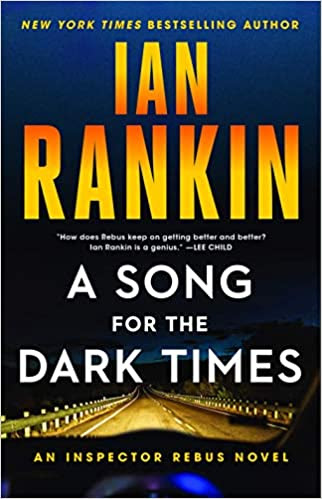
A Song for the Dark Times - Ian Rankin


With the exception of a five-year break between Exit Music and Standing in Another Man’s Grave (and the four-year break between the first two books), Ian Rankin has published a new John Rebus novel every year or so since 1987. There are now twenty-three Inspector Rebus novels, and Rankin has pretty much aged Rebus in real-time as he adds to the series. If I recall correctly, Rebus is already 41 years old at the beginning of the first novel in the series, so he should be in his mid-sixties now. And it figures that he is now a retired Scottish cop who still thinks of himself as a cop first…and not much else second. But a man suffering from a worsening case of COPD? I don’t think I was quite ready for that one. But considering Rebus’s hard-drinking, heavy-smoking lifestyle, I guess I shouldn’t have been so surprised.


John Rebus has never been much of a family man, and since his divorce years earlier, he hasn’t even been much of a father. It’s not that it doesn’t bother him, but Rebus seems to have ever only half-heartedly attempted to mend fences with Samantha, his only daughter. There is a degree of frostiness between the two still even though Samantha now has a daughter of her own. But when Samantha calls her father in a near panic because her partner has gone missing, and she has no one else to turn to, he comes running. 


Rebus, who is in the process of moving to his new downstairs flat because he can no longer do the stairs to his old place without stopping for a break or two along the way, immediately drops everything and heads to the Scottish coast to see what he can learn about the missing man. As the old cop he is, Rebus understands that if the man turns up dead, the locals will be looking at his daughter as their prime suspect. He also knows that even if he thinks she is guilty, he is not about to let her go to prison. 


Rankin, as he so often does, juggles two separate plot-lines along the way in A Song for the Dark Times until some of the same names start to pop up in both investigations. He keeps his readers in the loop on the Edinburgh investigation via Siobhan Clarke, Rebus’s old protégé, who informally teams up there with another recurring character, the outsider cop Malcom Fox. Both investigations are relatively complicated ones involving multiple investigators and suspects, and in the hands of a lesser-writer it all may have been a little difficult to follow, but  that’s a problem you never have with an Ian Rankin novel.


Bottom Line: The five-year break in John Rebus novels happened because Exit Music (2007) was intended to be Rebus’s “last murder case.” The inside of the book jacket even says, “Exit Music marks the final outing for the legendary Inspector John Rebus, and it proves that Edgar Award winner Ian Rankin has saved the very best for last.” But then it happened: six new Rebus novels since 2012. And what a great thing that has been. Rankin has figured out a way to keep Rebus viable and involved while strengthening the Siobhan Clarke and Malcom Fox characters at the same time. Here’s hoping there’s still a lot more to come from Inspector Rebus and his “team” before he has to resign himself to an easy chair and an oxygen machine. 


Ian Rankin


Bonus: This made me laugh in the way it so perfectly describes Rebus’s current status. It’s a scene in which Rebus is trying to convince someone that he is still a cop by claiming he’s really Malcom Fox:


‘Colin, this is Mr. Fox, a detective from Edinburgh,’ Belkin began to explain.

‘Oh, aye?’ He didn’t sound entirely convinced. ‘Bit long in the tooth, aren’t you?’

‘I’m younger than I look.’

‘Bloody well have to be.’ The gardener went to the sink, rinsing his hands and drying them on a towel his wife handed him.

Saturday, December 05, 2020

12 Detective Series, 220 Books...135 of Them Read

One of the goals I set for myself coming into 2020 was to do as much catching up on the many detective series I read as I could comfortably fit into my schedule. I finished the latest John Rebus novel from Ian Rankin this morning before the Texas A&M football game, and that got me curious enough to check on my progress.  

And, I've made more progress than I thought:


The John Rebus novels by Ian Rankin:

  • 23 in total (1987-2020)
  • 12 read
  • 3 Read during 2020
  • Read novels include first 4 and last 5
  • British author
  • Set in Scotland
The Armand Gamache novels by Louise Penny:
  • 16 in total (2005-2020)
  • 13 read
  • 4 read during 2020
  • Read novels include first 4 and last 7
  • Canadian author
  • Set in Canada
The Walt Longmire novels by Craig Johnson:
  • 16 in total (2004-2020)
  • 14 read
  • 4 read in 2020
  • Read novels include first 10 and last 4
  • American author
  • Set in the U.S.
The Duncan Kincaid/Gemma James novels by Deborah Crombie:
  • 18 in total (1993-2019)
  • 8 read
  • 2 read in 2020
  • Read novels include first 2 and 4 of last 5
  • American author
  • Set in England
The Inspector Banks novels by Peter Robinson:
  • 26 in total (1987-2019)
  • 7 read
  • 1 read in 2020
  • Read novels are first 5 and last 2
  • British/Canadian author
  • Set in England
The Harry Bosch novels by Michael Connelly:
  • 23 in total (including Bosch/Ballard novels) (1992-2019)
  • 12 read
  • 0 read in 2020
  • Read novels include last 6
  • American author
  • Set in the U.S. 
The Charlie Resnick novels by John Harvey:
  • 13 in total (1989-2013)
  • 12 read
  • 0 read in 2020
  • All read but number 7
  • British Author
  • Set in England
The Thomas Lynley novels by Elizabeth George:
  • 20 in total (1988-2018)
  • 17 read
  • 0 read in 2020
  • read novels include first 14
  • American author
  • Set in England
The Alexandria Cupidi novels by William Shaw:
  • 4 in total (2016-2020)
  • 2 read
  • 2 read in 2020
  • read novels are first 2
  • British author
  • Set in England
The Inspector Wexford novels by Ruth Rendell:
  • 24 in total (1964-2013)
  • 8 read
  • 0 read in 2020
  • read novels are scattered 
  • British author
  • Set in England
The Adam Dalgliesh novels by P.D. James: 
  • 14 in total (1962-2008)
  • 7 read
  • 0 read in 2020
  • read novels include first 4
  • British author
  • Set in England
The Dave Robicheaux novels by James Lee Burke:
  • 23 in total (1987-2020)
  • 23 read
  • 1 read in 2020
  • American author
  • Set in the U.S. 
There you have it. I prepared this largely for my own edification, but hopefully I've included enough data that other readers will find it at least a little bit useful.

Friday, December 04, 2020

A Share in Death - Deborah Crombie

Deborah Crombie’s 1993 A Share in Death is the author’s introductory novel in what is now her 18-book “Duncan Kincaid and Gemma James” series. I was particularly late in discovering the series for myself, and only started reading it when the cover of No Mark Upon Her managed to catch my eye in a bookstore toward the end of 2011. I’ve now read almost all of the novels that followed that one, but I’m just now going back to pick up the series from the beginning. As it turns out, though, I’m happy it worked out that way — for a reason I’ll explain a little later.


Most of you know that Duncan Kincaid and Gemma James work for Scotland Yard. When this first book begins, Kincaid is a Superintendent there and Sergeant James reports directly to him. Most of you know, too, that the two will ultimately get together and raise a remarkable family of their own. Just be aware that they are nowhere near that point in their lives — and that they don’t make much progress in that direction — in A Share in Death. 


As the novel begins, Duncan is about to begin a vacation at a small luxury timeshare hotel courtesy of a cousin of his who could not be there himself for his scheduled week. Duncan  prefers to keep as low a profile as possible among his fellow guests, so he does not introduce himself to anyone as a policeman. Thanks to a chatty staff member, though, he still learns the backgrounds of most of the other guests before actually meeting them because the others are well-known regulars  to hotel staff. Duncan’s anonymity comes to a quick halt the next morning, however, when a dead body is discovered by two children in the hotel’s whirlpool bath. Local authorities are ready to write off the death as a suicide, but Duncan doesn’t believe that is what happened. Soon, he is butting heads with local investigators while using Gemma to run down leads that he develops while digging into the backgrounds of his fellow guests. 


Bottom Line: A Share in Death is a good, solid introduction to the Duncan Kincaid and Gemma James characters. It establishes that Duncan is an attractive young investigator whose career is still on the rise, and that although he is still single, his head is relatively easily turned by the women he encounters. Gemma, on the other hand, has already been through a relationship that resulted in the toddler son she is now raising on her own. The two do not see each other face-to-face here until perhaps the last ten percent of the book, so readers are given no real reason to suspect their eventual union other than the fact they each seems to much admire the investigatory skills of the other. The mystery at the core of the book is the classic “closed door” kind of tale in which a murder is committed by one of a very limited number of potential suspects. Crombie handles it all competently enough, but I doubt I would have gone looking for other books in the series if I had started with this one. And…that is why I’m happy that I started out with book number 14 rather than book number 1. 

Tuesday, December 01, 2020

Book Chase: The December 2020 Reading Plan

 I only realized a few minutes ago that this is December 1, so I'll give a briefer than usual update on my reading plans/schedule for this last month of 2020: 

I've been looking forward to getting my hands on a library copy of this new Inspector Rebus novel for a while now. I was finally able to pick it up yesterday, and I've read the first couple of chapters already - and feel right at home being back in Rebus's world. I have to admit it was a bit of a shock to see that Rebus was in the process of moving from his longtime upstairs flat down to a ground-floor one in the same building because of the progression of his COPD. Why are all my favorite fictional detectives getting old at the same time? Don't answer that.

I am just over halfway through this 440-page Civil War novel now, and I'm enjoying the ride. I Jonathan is a recounting of the war through one man's eyes, a young man from Boston who found himself stranded in Charleston, South Carolina, when the war broke out. It has been interesting to watch the evolution in his thinking about the War and its causes. The story is being told by an elderly man to his great-nephew over a period of several visits by the nephew to a nursing home. 


A Share in Death was the very first Kincaid and James mystery, and it goes all the way back to 1993. I'm actually listening to the audiobook version of the novel right now, and it will probably be the first thing I finish in December. The novel is a good introduction to the Duncan Kincaid character, but I'm almost done with it and Kincaid and Gemma James have still not seen each other face-to-face despite her being one of his direct-report staff. The plot seems a bit old-fashioned both in its details and in its execution.


I'm a big fan of Robert Dugoni's writing, but I've never read one of of his Tracy Crosswhite books. Because this is already the eighth book in the series, I'm hoping that jumping in right here is not a mistake. Apparently Tracy is just returning to the Seattle Police Department where she is reassigned to the department's Cold Case unit. The problem she faces is having to investigate two cases at the same time: the kidnapping of a 5-year-old girl and the disappearance of a female jogger who never came home.


Strongheart is book number three in Jim Fergus's "One Thousand White Women" series. The books follow the lives of several hundred white women who went to live with the Indians as a gesture of goodwill and peace. The women all supposedly volunteered to move to the West and become Indian brides, but most all of them were found in prisons, insane asylums, and houses of prostitution. The women prove to be  surprisingly strong in body and spirit, however, and most of them thrived in their new lives. I've enjoyed the first two books.


Stillicide is a strange book I discovered in this Sunday's New York Times Book Review. It is a glimpse at one possible future for the world that we'd best avoid. After a worldwide draught, water has become a commodity, and countries are competing for their share of what's available. Whoever controls the world's water supply is in a position of power. As the novel begins, a huge iceberg is headed for London but terrorists are determined to damage or destroy the city's water pipeline. That can't be good.


I feel like I've seen about a dozen books with this cover-style in the last few months, but it's another one I just discovered on the NYT Book Review a couple of days ago. It's the memoir of an "indigenous" woman and it was a bestseller in Canada. The U.S. version has supposedly been updated to make it more applicable to readers here, and I'm curious to learn more about the lives of modern Native Americans and what kind of racism they have personally experienced. 


I didn't manage to get to Dark Passage in November, so I'm moving it to my December list. Part of my reading goal coming into 2020 was to read some of the novels published during the middle third of the 20th century, and this one fits nicely into that goal. Movie fans may remember this as a movie starring Humphrey Bogart - one I think I must have watched at some point in my life but, if so, I remember nothing about. David Goodis is described as someone whose style helped "transform American culture and writing," so I'm expecting a lot from this.

These are my first selections for December reading. It's not likely that all eight will get read, but it's a start. I have at least a dozen books on hold at the library, so anything that comes in with a shorter time fuse will bump some of these all the way into my 2021 reading.