Monday, May 25, 2015

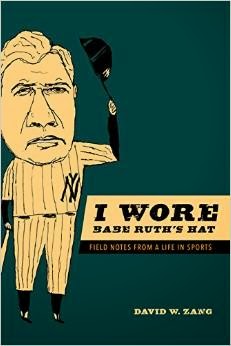
I Wore Babe Ruth's Hat

David Zang’s I Wore Babe Ruth’s Hat is a bit hard to describe.  It is probably easier to describe what it is not rather than what it is.  Zang has not written one of the more common sports books exposing some kind of doping or recruiting scandal, or a coaching manual, or a motivational exercise, or even a memoir about a championship season from his youth (be it amateur or professional).  No, this is, instead, a book celebrating the role of sports in everyday life, a look at how amateur sports, by teaching us how to play and enjoy life, helps give meaning to ordinary lives all over the world.

David Zang tells us a bunch of stories here, stories in which he is sometimes the central character and sometimes only one of the minor ones that populate the tales.  One of my favorites is the book’s first, “Chip Hilton’s Sports Cult,” because it reminds me so much of my own early reading experiences.  Many boys, not long after they start reading independently, discover the world of sports fiction written especially for boys and girls their age.  Most often, I suspect, the books are about baseball teams and they come in long series that completely capture the imaginations of those lucky enough to discover them.  For the first time in their lives, young readers like Zang and countless others are exposed to the life lessons that sports can teach.  Very likely, kids who read these books are sports fans for the rest of their lives.  Zang, however, via his adult eyes, does point out that much of what the books have to say about sports building character, and losing and winning, is in fact more myth than reality. 

Zang shares his sports failures right along with his more successful efforts.  An early chapter, for instance, focuses on his experiences as part of his high school wrestling team, not a sport in which the author exactly covered himself in glory.  And his recall of those seasons is impressive.  Amusingly, however, while doing research for I Wore Babe Ruth’s Hat, Zang found out that a couple of his old opponents remembered the details of those old matches differently than he remembered them – if they remembered them at all.

David W. Zang
There are stories about the basketball teams Zang played on; about his decision, as a kid, to blow off the rare opportunity to shake Jackie Robinson’s hand when the man was standing all alone just a few feet from him; about the evolution of college football; about the time in the basement of a Baltimore museum he slipped the Babe’s hat (not his baseball cap) on his head when no one was looking; about cheating in sports; about marathon running; about dressing as the field mascot for the Baltimore Ravens; and about impossible dreams.  Each of the stories is filled with Zang’s astute observations and conclusions, some of which are bound to surprise most readers – and some that will directly contradict what they think they know about sports.


Part memoir, part sports book, I Wore Babe Ruth’s Hat, has a lot to offer.

Sunday, May 24, 2015

How One Middle School Librarian Changed a Life

THIS is the kind of story I always look for but seldom find, one about the positive difference a good, caring teacher (in this case a retiring librarian) can make in a young life by introducing a student to the countless joys of reading.  Anyone who bothers to read a book blog (like you guys) already knows this, but for a child there can be nothing more exciting than opening up a whole new world they never suspected even existed.

From the News Star comes the story of one librarian and the 13-year-old boy whose life she so dramatically impacted:
If you fret that books are doomed, maybe Ian Golsby’s seventh-grade perspective on the joy of reading will inspire you.
And if you forget what a difference educators make, perhaps Debby Macy, retiring middle-school librarian at Herndon Magnet in Belcher, will remind you.
“She encouraged him to expand his reading horizons,” mom Julie Golsby says, “and has had such an impact.”
Ian agrees.
“I only knew one kid there, so one of the first things I did was go to the library. She helped me find some good books,” he said.
Now finishing seventh grade and with a long list of favorite books and a host of friends (”They all love reading, which is good.”), Ian gives “Miss Macy” the credit.
“Without her, I don’t know if I’d be where I am,” he says on a busy week, between a track meet and going to a movie with friends. “She’s kind of the reason I’ve been able to fit in so well. She always listens.”
And, yes, her retirement after 41 years is hard on him.
To learn more about this remarkable Louisiana librarian and the legacy she leaves behind in the heart of one little boy, please read the whole article.  

Click here to read the article from News Star.


Friday, May 22, 2015

Are Avid Readers "Suffering" from a Compulsive Behavior Disorder?

I'm just thinking out loud here, so bear with me for a minute.

Are all/most avid readers, the ones who read anywhere from something like 75 to several hundred books per year, victims of some sort of compulsive behavior disorder?  If so, I suppose that the consolation is that it is a rather healthy one compared to folks who are addicted to gambling, pornography, or washing their hands hundreds of times a day.

And if so, would anyone "suffering" the disorder actually choose to be cured of it?  I know that I would not.

I believe that book lovers are born, not made, that if the book-loving-gene is not present at birth, there is very little possibility that a person can be transformed into someone who reads every day of the year.  Now, that's not to say that a born book lover cannot be fine tuned into a "super" book reader, one of those 200-books-a-year types.  My theory is that those lucky enough to live in a home filled with books and people who take obvious pleasure from reading them will almost alwyas dedicate more and more of their own personal time to reading.  But turning someone who has no desire to pick up a book into someone who reads even 26 of them a year?  That's a miracle, my friend.

So.  Are you the "victim" of a compulsive behavior disorder that demands that you read every day...and more importantly, that you read as many books per year as you possibly can?

Well...

  • Are you compelled to read a certain number of pages per day?
  • Are you compelled to read at least one more book this year than you read last year?
  • Do you eat lunch alone so that you can read?
  • Do you read while brushing your teeth because no one can possibly expect you to talk then?
  • Do you carry a spare book in your car at all times?
  • Do you read in bank lines, in doctors' offices, and anyplace that will require you to wait in a line for even five minutes at a time?
  • Have you actually started looking forward to the down-times where you are forced to wait for service so that you can sneak in a little reading time?
  • Do you keep a book on the front seat of your car that you can grab while stopped at exceptionally long traffic lights?
  • Are you always looking for the next great read?
  • Are you a daily book-blogger?
  • Do you follow twenty or thirty other book blogs and consider all twenty or thirty of the bloggers to be personal friends of yours?
  • Do you sometimes find yourself secretly competing with your friends to see who can read the most books in a given year?
And that's just a start.

If you answered yes to more than one or two of these questions, you might be a "compulsive reader."  And, I'm willing to bet that you have been this way for most of your life.

And I whole heartedly applaud your efforts.  Keep up the good work.


Thursday, May 21, 2015

The Joy Luck Club

I began 2015 hoping to finally read some of the books that have been sitting on my bookshelves, almost untouched, for the past decade or two...or three.  So far, I have read five books from the past; The Joy Luck Club is the first one reviewed here.
--------------------------------------------------------------------------------

The Joy Luck Club, Amy Tan’s 1989 debut novel, got such a good critical reception that it firmly established her literary reputation.  Tan has now written six additional novels, one novella, one work of nonfiction, and some children’s books, but none has received the level of acclaim earned by The Joy Luck Club. 

The novel centers itself on the mahjong club started by four Chinese women who came to the United States after fleeing the Japanese invasion of their homeland during World War II.  After becoming friends as part of San Francisco’s Chinese community, the women started the club as a way to socialize and enjoy each other’s cooking.  (Their husbands come for the food.)  By the beginning of the novel, however, one of the women has died and been replaced in the club by her American daughter.

Tan structured the novel into four sections of four interlocking stories each in which she explores the relationships between the elderly women and their daughters.  The stories emphasize how little the daughters know (or care) about their mothers’ pasts and how manipulative and competitive their mothers are.  These are stories about mothers who often hurt their daughters and, in turn, about daughters who even more often hurt their mothers.  But in the end, it is a story of what happens when mothers and daughters finally learn to forgive each other – as difficult a chore as that usually is.

The first section, “Feathers from a Thousand Miles Away,” is introduced by Jing-Mei, whose deceased mother is credited with the founding of the Joy Luck Club.   Jing-Mei’s introduction is followed by three stories in which each of the surviving elders tells a story about her childhood in China.  Section two, “Twenty-Six Malignant Gates,” in turn, allows each of the American daughters to recall a key incident or influence from her own childhood in San Francisco.

Amy Tan
It is in the book’s third section, “American Translation,” that the reader learns just how difficult it has been for each of the older women to raise a daughter in the U.S.  It becomes apparent from the stories told in this section by the daughters that their mothers’ efforts to turn them into highly successful, competitive women have not been entirely successful.  The younger women, having now survived all the trials of first generation Americans, still resent the degree of intrusion into their lives that their mothers insist upon.


Finally, in the fourth section of the book, “Queen Mother of the Western Skies,” the mothers recall stories of their own young adulthood, that period during which they were most active in trying to form the personalities of their daughters.  With this section, the influences upon both generations of women are exposed for what they are, and the circle is closed.  Now it is up to them to find ways to forgive, understand, and love each other.

Wednesday, May 20, 2015

Book Trailer of the Week: The Shepherd's Life


I can hardly believe I'm saying this, but this looks like a book I would enjoy a lot.   I'm a fan of memoirs/autobiographies that give me a peek into the kinds of lives or locales I'm never likely to experience for myself, and...I'm never going to be a shepherd, right?  So why not read The Shepherd's Life instead?

This, I think, speaks once again to the degree of influence that a well produced book trailer can have.  (I still love book trailers.)  

Tuesday, May 19, 2015

The best thing about owning your own bookstore?

Ann Patchett
The best thing about owning your own bookstore?  According to author Ann Patchett (owner of Nashville's Parnassus Books) its the "enormous boon it was to her lifelong preoccupation with forcing books on people."  According to this article in The Washington Post, Patchett has been "forcing books on people" since she was a little girl:
After all, I’ve been telling people what to read since I was able to recognize words on paper. I was the kid extolling the virtues of “Charlotte’s Web” in the school cafeteria. “Fern saves the runt from being killed,” I told my friends. “And so her father lets her keep him.”
And now that Patchett is beyond all the logistics of getting her bookstore up and running, she finds that her greatest pleasure comes from introducing readers to her favorite books, be they new or old ones:
They’ll walk right up to me and say, “I’m looking for a book.” I wait for a minute, thinking surely there’s going to be more to that sentence — “I’m looking for a book I heard about on the radio” or “I’m looking for a book like ‘The Goldfinch’ ” — but often there is nothing else. They just smile up at me, trusting and curious, waiting to follow my instructions. It makes my heart soar.
Parnassus Books, Nashville
 I'm in the planning stages for my annual road trip during which I wander randomly in an eastwardly direction exploring towns and cities I've never (or seldom) had the opportunity to visit before.  This year (as I did two years ago), I am going to spend four days in Columbus, Ohio, at the Musicians Against Childhood Cancer benefit concert.  But on the way there, and especially on the return trip home, I will be doing some serious wandering around.  Some years I concentrate specifically on baseball parks or Civil War battle sites, but I've never really done a trip focused on indie bookstores.  Maybe this is the year finally to do that bookstore tour - before anymore of them disappear forever,

So now comes the planning bit...which amounts to nothing more than a list of indie bookstores and their locations and hours.  Then as I travel (not completely) aimlessly through a dozen or so states during my return to Houston, I will be able to use the list as a heads-up to which bookstores are in the general area.  

First store on the new list will be, of course, Ann Patchett's Parnassus Books...