Thursday, February 05, 2015

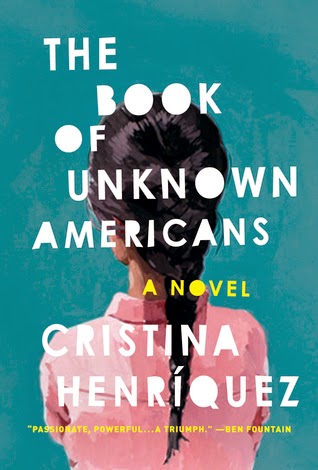
The Book of Unknown Americans

Cristina Henriquez’s The Book of Unknown Americans is the story of a group of immigrants, some of whom came to America legally and some who did not, who live in the same Delaware apartment building.  They are from places like Mexico, Guatemala, and Panama, and to each other, they do not always seem to have a lot in common.  But what they most certainly do have in common is the single most important thing about them: they are in the United States to create better lives for themselves and their children.  They are among the bravest and the most desperate of people.

Henriquez tells their story through two principle voices: Alma, a young Mexican mother; and Mayor, a Panamanian teen who falls in love with Alma’s daughter.  In addition to these two narrators, numerous minor characters are given voice in short bursts of first person narration interspersed between the alternating chapters from Alma and Mayor. 

Alma and her husband have just arrived from Mexico with their daughter Maribel, a beautiful teenager suffering the effects of a traumatic brain injury she suffered there.  Having come to the U.S. legally, they are here strictly to get Maribel the kind of special schooling that is not available to her in their home country.  Mayor’s family, on the other hand, left Panama years earlier when his parents decided that Panama was too dangerous a place in which to raise a family.  The family has been in the U.S. long enough now that Mayor and his older brother think of themselves as Americans, not as immigrants from Panama.

Cristina Henriquez
As different as the residents of the building are, they function more as an extended family than as a bunch of people who just happen to live in the same apartment building.  New residents, most of whom barely speak English, are quickly taken under the wings of those who have been in the building long enough to understand all subtleties and shortcuts associated with their shared situation.  On weekends, the families sometimes gather for meals where the men tell “war-stories” about their jobs, the women tell stories about their children, and televised soccer matches blare in the background.


The Book of Unknown Americans, while it does effectively put human faces on a few of the often indistinguishable thousands of Latin Americans immigrating to the U.S. each year, paints such an idealized picture of them that it loses much of its impact and sense of realism.  Unfortunately, this gives the novel just enough of a one-sided feel that many of its characters become more stereotypical than authentic.  Alma, Maribel, and Mayor, though, are such sympathetic characters that their story is an interesting one worth reading.

Wednesday, February 04, 2015

Amazon Is At It Again: Kindle Convert

Amazon has just announced a new piece of software (that goes for $19 now while it is on sale at an introductory price) that will allow the user to convert his own tree-books into Kindle-compatible e-books.

When I first saw the headline, I thought this might be something useful for people like me who own a few books that were printed in the second half of the nineteenth century.  But then I read the details and spotted a few "problems."

1.  The software only works on computers running Windows 7 or Windows 8.  Mac (and Linux) users need not apply.

2.  So first I have to drag out that Windows 8 PC that I hate so much BECAUSE it uses Windows, and then wait forever for it to finally finish its frustrating start-up procedure.

3.  Then I have to very slowly and precisely scan each page of the book so that the software can convert everything into an e-book for me.  (Do you have any idea how long it will take to scan a 500-page book, even two pages at a time?)

4.  Then, depending on how much luck I had in scanning every page correctly, I have to hope that the software will do its own job correctly - and by then I will have already invested what are likely to be several hours in the process.  (I wonder if individual pages can be rescanned if I mess up somewhere around page 360.)

5.  Today's flatbed scanners don't really lend themselves to massive scanning projects like those this software requires.

I have a better idea, PUBLISHERS.  Why not make an e-book available at no extra cost for every new tree-book that I purchase from you?  Sure, I know you will kick up the price of the physical book a few bucks...but shouldn't, say, three dollars cover this since you are going to sell many more e-book copies this way than you otherwise would have? 

Or, AMAZON why can't you do this for all the tree-books I've purchased from you already?  You did something very similar with all the music CDs I have purchased from you in the last decade.  You want to lock me in as an e-book and tree-book purchaser?  Just say yes.  Do it.  Then I would have my permanent copy of a book on the shelves, where it belongs, but have a spare reading copy always at my fingertips.

The Kindle Convert software is still somewhat intriguing, I admit, but it is a nonstarter for me because of the scanner limitations with which I would have to cope in order to make the process work.  And no matter how good the software might be in the future, if it remains incompatible with Apple's operating system...no thank you.

Tuesday, February 03, 2015

Harper Lee to Publish New Novel About Scout

Harper Lee
News flashes make me nervous these days.  Last thing I want to do is hear of another war, beheading, terrorist attack, or bad economy indicator.  But about five minutes ago, something came across my desk from CNN that made me smile out loud:

Harper Lee is going to publish a new/old novel.  Go Set a Watchman features her beloved character Scout from To Kill a Mockingbird, but this one features the adult version of Scout. Ms. Lee says that, in it, Scout often flashes back to her childhood, and that is what caught the attention of her editor - who suggested that she start over and write a different novel actually set in that period of Scout's life.  The rest is history.  To Kill a Mockingbird became an international sensation...Go Set a Watchman was filed away for 55 years.

According to CNN, Harper had this to say:
"I was a first-time writer, so I did as I was told. I hadn't realized it (the original book) had survived, so was surprised and delighted when my dear friend and lawyer Tonja Carter discovered it. After much thought and hesitation, I shared it with a handful of people I trust and was pleased to hear that they considered it worthy of publication. I am humbled and amazed that this will now be published after all these years."
The book will be published in mid-July, and if this is not the publishing event of 2015, I will eat my St. Louis Cardinals baseball cap.

San Francisco's Borderlands Books Killed Off by Minimum Wage Increase

The Law of Unintended Consequences strikes again, this time in San Francisco.  

Voters there recently passed a city initiative that raises the minimum wage in stages - to the point that it will reach $15 per hour in July 2018.  It is currently $11.05 an hour.  All well and good in theory.  But for small businesses already struggling to survive, the increased labor cost might just be the proverbial straw that breaks their backs.  

Case in point: Borderland Books, the city's popular sci-fi and fantasy bookstore.  According to a news story filed by San Francisco's ABC television affiliate, the bookstore's customers are shocked to learn that they have effectively voted it our of existence.
Borderlands was turning a small profit, about $3,000 last year. Then voters approved a hike in the minimum wage, a gradual rise from $10.75 up to $15 an hour.

"And by 2018 we'll be losing about $25,000 a year," he said.

It's an unexpected plot twist for loyal customers.

"You know, I voted for the measure as well, the minimum wage measure," customer Edward Vallecillo said. "It's not something that I thought would affect certain specific small businesses. I feel sad." 

Though it's caught a lot of people off guard, one group that wasn't completely surprised was the Board of Supervisors. In fact, they say they debated this very topic before sending the minimum wage to the voters.
I don't want this to turn into a political discussion because that generally gets people nowhere.  But I do have a degree in economics, and I have to say that no one should have been blindsided by this kind of thing.  A wage increase of this proportion invariably leads to an uptick in unemployment and prices.  If consumers are unwilling to pay the higher prices needed to cover increased wages, businesses fail and people are out of work.   It's really pretty simple.

Monday, February 02, 2015

Lone Star Noir

Lone Star Noir is another short story collection in the Akashic Books series that I first discovered back in 2010.  Each collection in this series contains fourteen or fifteen stories that fit comfortably in the genre of noir crime fiction.  And, because each of the stories is written by someone from (or very familiar with) the city or region in which all of the stories are set, the collections are long on setting and mood.  I have previously read and enjoyed Boston Noir, Mexico City Noir, Long Island Noir, Manila Noir, Prison Noir, and Belfast Noir.  And now, I can finally add one of Akashic’s Texas books to that list.

I’m a Texas native, and other than a decade during which I lived in Europe and North Africa, I have spent my whole life here.  So, speaking from personal observation, I can attest to the validity of editor Bobby Byrd’s statement in the book’s introduction that “Texas, in all its many places, bleeds noir fiction.”  Lone Star Noir is, in fact, only one of the Akashic books set in Texas.

As usual in every short story collection I have ever read, Lone Star Noir includes both winners and losers.  Some of the stories grab you in the first paragraph – and one or two others might see the reader perplexed even after the last page has been turned.  Surprisingly, at least to me, the most disturbing and haunting story in the entire collection was written by a woman.

Claudia Smith’s “Catgirl” is set on the beaches near the island city of Galveston, a place where Texas parents take their children for a day or two in the usually warm waters of the Gulf of Mexico.  For children, it is a small slice of paradise.  That however, is not the case for the four little girls who learn about the real world one night from someone they trusted to keep them safe.

Some of the stories are set in the state’s largest cities, others in what seems to be the middle of nowhere.  The San Antonio story, Ito Romo’s “Crank,” shows what can happen to a big city boy unprepared to visit the meanest of his city’s streets – but believes that he is.  And then as if to remind the reader that major crime can occur in the smallest of places, there is “Preacher’s Kid,” a story by Jessica Powers.  Also in the mix, is Joe Lansdale “Six-Finger Jack,” a fine story about a bounty killing that the killer soon has reason to regret.  This one is set in the heart of East Texas, a region Lansdale knows as well as any writer out there.

There are way more hits than misses in Lone Star Noir and, as usual, I’ll be keeping my eyes open for other books in a series that has become one of my favorites.

Sunday, February 01, 2015

Shame on You, City of Shreveport

Little Free Libraries have been around for a while, and everywhere one of them pops up, the locals seem to love the idea and enthusiastically take to it.  (Well, I suppose I should limit the previous sentence a bit by saying that I have never personally heard anything negative about where any of the little library boxes are placed.  Such criticism is not something that would earn many national headlines, so it's easily possible that Shreveport is not the first city to start shutting down Little Free Libraries.)

As shown in the picture I clipped from the LFL site, the free libraries resemble overgrown birdhouses placed close to the ground.  Homeowners often place them near the street with a sign on them saying something to the effect of "leave a book, take a book."  And that's what people happily do...over and over and over again.

But now the city of Shreveport is spending city resources to shut the things down if the free libraries are placed in areas of the city not specifically zoned for commercial establishments.  Remember now, no money changes hands in a Little Free Library; everything is based upon the honor system.  If anything, the generous homeowners who do this for their neighbors take a loss on the whole project because the little structures cost at least $300 if purchased in kit format.  

According to this Shreveport Times article:
Alan Clarke, the MPC's zoning administrator, said the book swaps are, by definition, libraries equivalent to Shreve Memorial Library, and under city law a library can only exist in a commercially-zoned area.
Shreveporter Teresa Edgerton learned this after her husband opened a certified letter from the zoning division ordering them to stop operating their Little Free Library, a decorative structure containing books, outside of their Wilkinson Street home.
[...] 
There are at least two other registered Little Free Libraries in Shreveport and a number of unofficial lending boxes around the city, Turner said.
Clarke said the zoning division stands by its decision. "If someone tells us where one is then we will do the same thing that we did on Wilkinson," he said. "(We) only went there because it bothered someone."
So there you have it.  All it takes to shut down something positive is the combination of one petty paper-pusher with a city title and one busybody who is offended that a neighbor might attract the wrong kind of people to the neighborhood.

Shame, shame, shame on you two.