Tuesday, June 08, 2010

Books on Vinyl

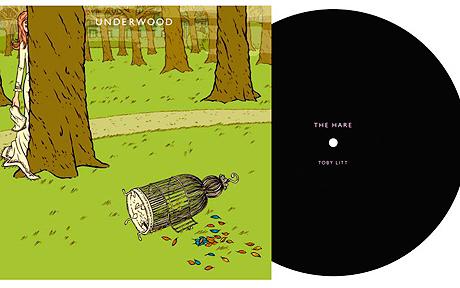
Now, this I like: short stories on vinyl.

It seems that a U.K. publisher has decided to "publish" short stories on 33 1/3 rpm vinyl discs under his new Underwood label (see the article to find out why he chose this name for his company - but I'm betting some of you already know the answer).
Nathan Dunne is either a very brave or a very stupid young man. At a time when a) the MP3 has supplanted the CD as the most popular format on which to listen to recorded sounds; b) literature as a physical artefact is coming under attack from the rise of iPads, Kindles and other digital reading devices; and c) the short story is as tricky to sell to publishing houses as it has ever been, Dunne has set up a new imprint called Underwood, whose remit is to produce 33rpm vinyl records featuring writers reading 20-minute short stories aloud. “Candidly, it’s an experiment,” he admits.
[...]
For Dunne, the current emphasis on the portability and ease of circulation of recorded sound rather than its sonic properties corrodes the intimacy of the listening experience.

“The MP3 has an alien digital gloss. It’s streamlined, corporate, like a mainline train station. Listening to a short story on vinyl is the purest antidote to that. It’s more immersive. It heightens engagement.”
This might just be crazy enough to work. I know I'm one of many thousands who still collect those old vinyl LPs that went out of style some time in the eighties. What better way for a vinyl collector to mix two hobby passions than "books on vinyl?"

For more information, please see the Telegraph article or go directly to the Underwood website.

Monday, June 07, 2010

The Short Second Life of Bree Tanner - Yours Free

Stephenie Meyer, in some sort of weird marketing campaign, is making her new novella, The Short Second Life of Bree Tanner, available on line where it can be read at no cost. Meyer does suggest that readers donate $1 to the American Red Cross since that is the amount being donated for every hardcover copy of the novella sold in bookstores.

So, if you don't mind reading an ebook version of the book on your PC or other WiFi device, this is where you can find it. Be aware that it is only available at this link until midnight, July 5.

It's not for me, but I thought some of you might be interested in reading or sampling the thing. If you do, please let me know what you think of it.

Sunday, June 06, 2010

Currently Reading

(Photo of Stephen King and son, Joe Hill)


I'm reading (well, one is an audio book) three very different books right now and, not unexpectedly, I find myself having very different reactions to them. As my sidebar indicates, I'm actually involved with four books at the moment but I've not picked up one of them for several weeks now, so I don't consider it to be active at this point.

I'm about 25% of the way through the audio book version of Paul Doiron's The Poacher's Son, a book about a Maine game warden whose poaching father is on the run in the Maine woods, suspected of having played a part in the gunning down of a policeman and a businessman. The story is interesting so far, though certainly not exceptional to this point, but I am really taking a dislike to the voice and delivery of the book's reader, John Bedford Lloyd. Lloyd's monotone delivery is fine for short periods but is dull and annoying for anything more than ten or fifteen minutes at a go. Lloyd's tone changed so drastically from the end of Disc 1 to the beginning of Disc 2 that, for a few seconds, I thought a new narrator had taken over the job. It turns out, though, that some anonymous sound engineer failed to keep the recordings set at the same parameters. I'm hoping this one gets better - and there's still lots of time for that to happen.

I'm about two-thirds of the way through Mr. Peanut by Adam Ross. This is an interesting look at the marriages of three men: one suspected of having murdered his wife by forcing her to eat something she was extremely allergic to and the two detectives trying to build a case against him. An interesting twist to this one is that one of the detectives is Sam Sheppard, the former doctor who had once been convicted of the murder of his own wife (based on the real Sam Sheppard's story). This is a well written novel and it is, by far, the most "literary" of the three books. I have a pretty high opinion of it so far and, depending on how the book plays out, this one should receive a high rating. It is, by the way, a debut novel, one apparently in the works for more than eight years.

And then there's Joe Hill's Horns, a horror novel about a young man who suddenly sprouts a nice set of devil's horns atop his head. The horns cause those exposed to them to share their innermost thoughts and wishes with the young man, often leading to disgusting admissions and truths he really does not want to hear about. Most of you know that Joe Hill is Stephen King's son and I'm starting to think that Joe has analyzed his father's work to the extent that his own writing is almost indistinguishable from his father's anymore. This is an ebook I downloaded from my library or I probably would not be reading it. As it is, at 50% of the way through the book, I'm still wondering why I'm bothering with it. Frankly, I'm finding that it is aimed at a whole different reading audience than the one I'm part of - and that "horror" has long since ceased to horrify or scare me at all. There's just too much content of the "gross out" variety to impress me that the book has much merit, and I'm only continuing it to find out the origin of the horns and whether the main character will finally shed them. At most, this will probably earn a 3.0 rating, maybe even a bit less.

I haven't abandoned a book in a good while, and seldom abandon them when at least 25% of the way through them, but Horns and The Poacher's Son are testing me.

Friday, June 04, 2010

Wales Out-Reads Rest of U.K.

At least that's what recently released statistics about U.K. library visits seem to say. According to the numbers (as noted at Wales Online) total library visits are down or stagnant everywhere in the U.K. except for Wales:
In total, across Wales there were almost 14 million visits to Welsh libraries, an increase of 3.7% on the previous year, according to the figures released by the Chartered Institute of Public Finance and Accountancy (CIPFA).

This compares with a year-on-year decrease of visits to English libraries of 1.4%, a decrease of 4.1% in Northern Ireland and a tiny increase of 0.4% in Scotland.
I'm a little surprised that library visits would be down anywhere these days considering how terrible the world economy is. Where else can so much great free stuff be found? I say free but, of course, it's all paid for with your tax dollars - so support your local libraries before our misguided politicians decide they should be cut back in favor of another stupid government giveaway program.

Take a look at the very cleverly designed Central Library in Cardiff. The outside of the building is meant to look like a set of bookshelves:

Thursday, June 03, 2010

Damp Squid: The English Language Laid Bare

The English language, perhaps the most flexible languages there is, continues to evolve at a rapid pace. Some believe this evolution to be a horror, the destruction of a once proud language; others believe it to be a wonderful thing, the very reason that spoken English is now the dominant language in the world. Jeremy Butterfield’s Damp Squid: The English Language Laid Bare is an entertaining look at the origins of modern English, the history of the dictionary, the sources of new words taken into the language, English grammar, and why so many English speakers are “wobbly” about spelling even some of the words they use every day (among other assorted topics).

Damp Squid is unlikely to convince every reader that the language’s readiness to create, borrow and steal new words is a good thing, but it will entertain them with its evidence. Along the way, for instance, readers will learn that, depending on who is doing the counting and whether or not technical terms are included in the count, there are somewhere between one and two million words in the English language. Dictionaries leave out more words than they include - even the largest of dictionaries generally list only between 300,000 and 475,000 words. While the average university student is said to have a vocabulary of some 40,000 words, he likely uses less than half of those words “actively.” In fact, 50 per cent of what we write consists of a mere 100 words and, astonishingly, the ten most used English words comprise some 25 percent of written words: the, is, to, and, of, a, in, that, have, I.

According to Butterfield, modern English is the offspring of five major linguistic influences, each of which, but for the last one, had a dominant period of influence on the language: Old English, French, Norse, Latin (and Greek), plus the other 350 languages of the world from which modern English picks and chooses words it finds useful. That, alone, explains many of our spelling issues.

Let’s face it, though; it is reasonable to assume that a book on lexicography is going to be dry, at best, and, at worst, just plain boring. Jeremy Butterfield manages to avoid both those pitfalls by including sections that compare the idiomatic phrases of several languages, discuss the most hated words and phrases in the language, deride the Grammar Nazis of the past and present, and illustrate how the meaning of some common words is changing even now before our very eyes.

Damp Squid is a surprisingly entertaining take on a topic close to the hearts of most avid readers and writers, definitely worth a look.

Rated at: 5.0

(Review Copy provided by Publisher)

Wednesday, June 02, 2010

When I Buy a Book, I Expect to Own It, Not Rent It

If I don't really own an ebook, why does one cost so much?

Are you as sick of the Kindle, the Nook, the iPad and the Sony Reader as I am? I am disgusted by the fact that the hardware manufacturers are so fixated on the idea that only books purchased from their own "bookstores" should be read on their readers - and on making sure their ebooks cannot be read on other readers. Sony, at least, uses the common epub format, meaning that I as a Reader owner can check out ebooks from my local library. But Amazon.com books will only play on the Kindle, and Apple store books will only play on the iPad and Barnes & Noble books will only play on the Nook. That's outrageous, especially considering the prices being charged for ebooks now that the Apple egomaniac has his own reader on the market.

Why should readers/customers pay such high prices for ebooks that will forever tie them to one particular reader? Ebooks are convenient under the right circumstances but, because I have nothing physical to hold in my hands, I can't help feeling that I'm being ripped off. I can't tell you how much emusic I've lost over the last few years when hard drives or mp3 players crashed. The same is certain to happen with ebooks (yes, I know that I can back them up to other drives, etc. - but who remembers to do that all the time or can find the backups when they need them?)

I'm a fan of the Sony Reader mostly because of the access it gives me to free ebooks at my library and because so many out-of-print books can be found on the web and transferred to my Reader. But I haven't purchased an ebook from Sony in well over a year and that's because I feel like I'm left with an empty bag after I finish reading an ebook. Barnes & Noble, despite using the same epub format as Sony, has apparently made sure that I cannot read one of the B&N-sold ebooks on my Sony Reader - according to the B&N staff I questioned at two local bookstores.

Amazon, Kindle and Barnes & Noble want to tell me how I am allowed to read my books and they want to limit my right to sell or loan them to others. Fine, guys. If the books don't really belong to me, why do you insist that I pay full price for them? Pick a damn format and let your three ebook readers speak to each other. That's not too much to ask, and your customers will buy more ebooks when you stop limiting their usage rights to what you sell them.

See this Epicenter link for a look at this issue from the publishers' point-of-view.