Happy New Year, all. It's always refreshing to turn the page on a new year, I know, but after the last two years we've all experienced, it somehow seems more important than ever to start this new year with a real sense of renewal and optimism. That's also led me to reconsider what kind of reading year I want to have in 2022.
I've decided that 2022 will be a year during which I read many more older books than I normally read. I want to spend the year catching up on some of my longtime favorite authors and exploring books and authors from the middle of the twentieth century. That means fewer new books, fewer review copies, and way less chasing the bright new pennies as publishers around the world mint them every month. That's not to say that I won't be reading any books published this year; I'll just have to force myself to be more selective...and I'll depend on you guys to point me in the right direction there.
Anyway, that's the plan for now, and January is looking something, I hope, like this:
This is the second book (1993) in Michael Connelly's Harry Bosch series. This is my favorite detective series of them all, and I started off 2021 by reading the first book in the series but never did work my way back to this second one. Interestingly, this is the novel in which Bosch discovers who his father was and that he has four half-siblings, including the character who later becomes well known to Connelly fans as the "Lincoln Lawyer." This one takes Bosch down into Mexico where he tries to solve the murders of two detectives.
Thomas Berger's 1964 novel, Little Big Man, is a classic of sorts. It was made into a successful movie in 1970 that starred Dustin Hoffman, but that movie struck me as much as an anti-Vietnam war movie as a good representation of Berger's long novel about a man who was captured by Indians as a child and spent the rest of his life passing between the two cultures. Jack Crabb, now 111 years old, is finally ready to tell the world his story when he suddenly dies...leaving behind his diaries. The novel is told in his words...and it's a hoot.
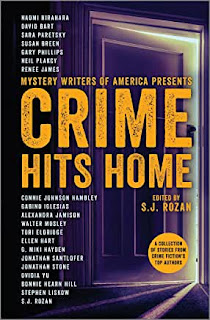
I committed to reading this one a few weeks ago. It's the third in a series of stories published by the Mystery Writers of America, and it is scheduled for publication in April 2022. I've read a few of the short stories in it now, and I was a little bit underwhelmed by the first ones I read. But I seem to have struck gold with the last few of them I've tried, so my appreciation for the collection is steadily growing. I'm unfamiliar with most of the authors, but that's part of the fun because you never know where just one story will lead you.
The Searchers is a 1954 novel by Alan LeMay that many people will remember as one of John Wayne's classic movies. From what I understand, the novel is a good bit darker than the movie was - and that was dark enough. It's the story of a man whose niece (I think) is taken captive by Indians, and what he goes through to get her back over the next six years. The darker aspects of the story come, as I recall, from the man's realization that he would rather see the young woman dead than alive if she has been raped by the Indians who hold her for so long. 
I've been itching for a while now to begin reading the Shetland series by Ann Cleeves but still haven't managed to get a copy of the first book in the series. Rather than wait any longer, I've decided to jump into the series featuring Shetland cop Jimmy Perez with its seventh book, Cold Earth (2016). It's not like I don't already know the characters anyway, since I first discovered the Shetland series via the PBS series and have watched three complete seasons of those shows. Still, though, that's not like reading the books.
After finally discovering Peter Robinson's Inspector Banks novels and reading the current ones for a while, I decided a while back to start reading from book number one in this twenty-seven-book series. So, it's time for book number six, Wednesday's Child (1992). Unfortunately, I saw a television version of this one a year or so ago, and the plot stuck with me more vividly than television usually does. I don't expect any real surprises now, but I do expect some complications and, hopefully, a side plot or two.
William Shaw is one of those authors that Cathy over at Kittling: Books turned me on to in 2021. I really enjoy the way this man tells a story, and this will be the fifth of his books I've read. It's one of Shaw's standalones, and it was published in 2014. Like his She's Leaving Home, another of his standalones, it is set in the "swinging sixties." It is billed on the book flap as "a battle for the soul of the city" (London) between "cops and criminals, the corrupt and the corruptible." It sounds as if the cops are little better than the criminals in this one.
This book has been languishing on my shelves since sometime in the eighties, I think. It's bright red cover catches my eye all the time, but I've not read even one of the four Paul Scott novels inside its covers. Time to fix that, so I hope to read Scott's 1976 novel The Jewel in the Crown in late January or early February. I did see, decades ago, some of the television series based on the books, so I know what to expect. The four novels total almost 2,000 pages in this edition, Now I remember why I never tried to read one of them before now.
This is the game plan for the beginning of the month. I don't expect to read all eight of these, but I do expect to read about ten books in total following the general guidelines I've set for myself.
And...we're off. Happy 2022 reading to you all!