Showing posts with label Library Book (2012). Show all posts

Friday, December 28, 2012

Half-Blood Blues


By the time I finally picked up a copy of Half-Blood Blues, Esi Edugyan’s novel already had quite a reputation going for it, the result of having won Canada’s Giller prize and having been a short-listed candidate for Britain’s Booker Prize.  I am happy to report that this story of three black jazz musicians, who find themselves trapped in Paris when Hitler’s Nazis overrun the city, largely lives up to that reputation – except for maybe a quibble or two I will mention later.

Sid Griffiths and Chip Jones have known each other forever.  The two grew up together in Baltimore where they honed their musical talents to so a high level - Sid on base and Chip on drums - that they would become popular in Berlin as the core of a jazz band they called the Hot-Time Swingers.  But they really hit the big time when they add trumpeter Hieronymous Falk to the mix.  Hiero, a mixed-race German, is so special a talent that he catches the attention of one Louis Armstrong - who invites the band to join him in Paris to cut a record.

The tough decision to shut things down in Berlin is made easy for the band when Hitler labels jazz as “degenerate music” and bans public performances of it.  When the Hot Swingers, including its German members, realize that more than their mere livelihood is at stake, the scramble is on to find papers good enough to get them across the border and on their way to Paris.  Little do they know it, but Hitler’s army is not all that far behind them.

Sid Griffiths, the book’s narrator, tells this intriguing story from the perspective of just over fifty years in the future.  Sid and Chip are old men living in 1992 Baltimore with plans to attend the imminent Berlin debut of a documentary film honoring the now legendary jazz trumpeter Hiero Falk.  Hiero, caught in a Nazi roundup of “undesirables,” has not been heard from since the day of his arrest and is presumed to have died in a Nazi death camp.  The mystery surrounding his arrest, details of which only Sid knows, have turned Hiero into the kind of musical legend that only dying young can do for a musician. 

Esi Edugyan
But Sid knows the whole story, and even though the truth is still eating at his soul, he does not really expect, or want, to go public with it.  Surprise, surprise, Sid.

Esi Edugyan has Sid speak in the vernacular of jazz musicians of the thirties.  While this initially slows the reader down, once the speech pattern becomes familiar, this technique gives Half-Blood Blues a feeling of authenticity it otherwise would not have had.  This does, however, bring me to my first “quibble.”  When Sid is thinking out loud for the reader, he sounds nothing like he does in conversation with his friends - even in 1992 – and that is sometimes a little jarring to the reader’s ear.

 But more importantly, the book’s ending does not quite measure up to the hugely dramatic build-up leading to it.  Perhaps unrealistically, I was hoping for more.  I did, however, still very much enjoy this one, and I suspect that I will be thinking about it for a good while, so if you like WWII history from a civilian point-of-view, you will likely love Half-Blood Blues.  Esi Edugyan is most certainly a talent to be watched.

Thursday, December 20, 2012

Book Finds: How to Find, Buy, and Sell Used and Rare Books


With one exception, Book Finds is an excellent reference for aspiring book collector/dealers and a good review for collectors who might be returning to the hobby after an absence of a few years.  The notable exception is the author’s limited handling of the multitude of online resources available to today’s serious collector.  (I am working with the book’s 2001 second edition, and there is a 2006 third edition that might be more complete in this area).  However, because of the rapid pace at which things change on the Internet, the author’s decision to present the information in summary fashion is probably as good as any.

But there is a lot more to Book Finds – and much of the information presented in the book is timeless.  Book Finds includes chapters covering “edition, condition, and scarcity;” the scouting of books; auctions and catalogs; collectible authors; collecting trends; signed vs. unsigned books; acceptable book repairs; safe ways to clean books; and dealing vs. collecting.  Depending on one’s previous experience, some of these chapters, particularly the ones regarding edition-identification and condition, have the potential of saving the reader a lot of money.

Five rules, according to Ellis, are the “glue that holds the process together,” and the new book collector or dealer will be wise to master each of them:

1.     “Specialization” – no one can know everything.
2.     “Condition” – when it comes to value, nothing is more important than condition
3.     “The Rule of Three” – “A book has to be worth three times what you just paid for it in order to make a profit on it.”
4.     “Keep Looking” – “Anything can be anywhere.” (attributed by the author to Larry McMurtry)
5.     “Trading” – “Never pay cash for a book when you can trade for it instead.”

Book Finds also includes an appendix, in alphabetical order, by publisher, showing how to recognize each publisher’s method of designating a book’s first edition.  While the appendix is far from being complete, the major publishers are included alongside some of the lesser-known publishing houses.  It is a good beginning reference that, for the more serious collector, can be supplemented by standalone volumes on the same subject.

Also interesting is the book’s final chapter, “1,001 (More or Less) Collectible – and Findable – Books.”  The list, more than a decade old now, is a fascinating look at which authors were hot at the turn of the new century, which others were expected to join them, and how easy it is to be wrong about collecting trends. 

These are interesting times for book lovers.  E-books threaten to replace tree-books, authors are self-publishing both in virtual and in print format, major publishers are struggling to find a business model that makes sense, and bookstores are disappearing as fast as record stores did in the early years of the century (and we all know how that saga ended).  Book Finds should help new book collector/dealers make sense of it all - and to make a little profit while they have a whole lot of fun.

Tuesday, December 18, 2012

This Is How You Lose Her


Junot Díaz’s This Is How You Lose Her, a nine-story collection, is the author’s follow-up to his 2008 Pulitzer-winning novel, The Brief Wondrous Life of Oscar Wao.  Seven of the stories were first published in The New Yorker between February 1998 and July 2012, one in Glimmer Train in 1998, and another in Story in 1999.

Reading these stories in the order in which they are presented here, one after the other, will be a greatly different experience than that had by those who read them over the fourteen-year period during which they first appeared in print.  This Is How You Lose Her, in fact, reads more like a novel than it does a short story collection.  This is because all of the stories, although they flip back and forth between segments of his life, feature the same central character already familiar to readers of Díaz’s two previous books.  Yunior, a young Dominican, along with his mother and older brother, came to the United States when he was just a boy, and these stories, in addition to telling how Yunior got here, detail what happened to him once he did.   

Be forewarned that these stories, insightful as they often are, are written in a raw, sometimes outrageous, style.  Díaz writes in a Hispanic street vernacular that sees him often mixing Spanish words into his sentences.  And, even though entire sentences are sometimes presented in Spanish, Díaz leaves it up to non-Spanish speaking readers to figure out what he is saying based on the context of the rest of the paragraph.  But that is the least of it.

Junot Diaz
Yunior is a womanizer, and he comes by it naturally.  His father, although not a constant in Yunior’s life, set the pattern for that lifestyle early on, leaving Yunior to learn all the moves by watching his older brother in action.  His is the kind of macho culture in which women are primarily objects to be sexually exploited, and Yunior describes in explicit terms what he gets from the women who briefly pass through his life. 

Some might find Yunior’s language offensive, but it is exactly this style and language that make Díaz’s stories as powerful and effective as they are.  However, one does begin to wonder how long such a distinctive style can be mined before it goes stale for the reader.  Even though this is my first experience with Junot Díaz’s work, I already wonder how much more of it I can read before the style becomes tiresome.  Díaz is definitely on my radar now, but I am more likely to wait for something new from him written in a different voice than I am to seek out either of his two earlier books.

This Is How You Lose Her is a book about heartbreak – and the very macho central character, surprisingly enough, suffers much of it himself.

Monday, December 10, 2012

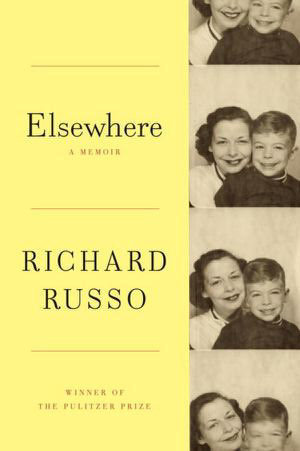
Elsewhere


Elsewhere is not so much a Richard Russo memoir as it is the author’s frank recounting of life with his mother, a woman for whom he pretty much took responsibility while still in high school.  As Russo puts it in the book’s prologue, “What follows in this memoir – I don’t know what else to call it – is a story of intersections: of place and time, of private and public, of linked destinies and flawed devotion.  It’s more my mother’s story than mine, but it’s mine, too, because until just a few years ago she was seldom absent from my life.”  The key word in this explanation is “flawed,” because, as Elsewhere makes clear, the author allowed his mother’s undiagnosed obsessive-compulsive disorder largely to define his own existence, even after he married and was raising a family of his own.

As he begins to describe his childhood in Gloversville, New York, readers of his fiction will recognize that the upper state tannery town provides the basic setting of much of Russo’s fiction.  But Gloversville, once a proud producer of high quality leather products, was already in decline by the time Russo’s 1950s childhood began.  By then, automation and cheap foreign labor - along with the negative environmental impact associated with the tanning of leather – was killing both the town and some of its citizens. 

Richard Russo
The anxiety condition that Russo’s mother lived with all her life went undiagnosed.  Everyone around her, including the husband who left her when Richard was just a boy, found her impossible to live with, but more often than not, they wrote off her behavior as just a bad case of “nerves.”  Russo, to his great credit, assumed primary responsibility for his mother from the moment she decided to follow him across the country to Arizona to begin his college career.  This would not be the last time Mrs. Russo changed addresses because her son did.  She would do so for the rest of her life.

One gets the sense from reading Elsewhere (some ideal spot only in his mother’s mind where she could finally live the life she deserved), that Russo still does not realize how great a personal sacrifice he made for her all those years.  He readily admits that, despite all he did for her, he feels that he failed his mother by accepting her condition as an untreatable one – a passive approach, he tells us, that he has taken with no other problem he has ever encountered. 

The bad news here is that Elsewhere is not the memoir most Richard Russo fans were expecting or hoping for; the good news is that this one leaves a lot for Russo to tell in a second memoir.  

Monday, December 03, 2012

Black Dahlia & White Rose


I have been reading Joyce Carol Oates for decades and I still do not know how she does it.  Now in her mid-seventies, Oates is producing some of the best, and darkest, fiction of her career – and she does it at a pace that would shame most writers half her age.  The quality and impact of her latest short story collection, Black Dahlia & White Rose, makes me believe that Ms. Oates will continue to write memorable fiction for a long time to come.  Thankfully.

Black Dahlia & White Rose is a collection of eleven short stories recently published in magazines such as Playboy, Harper’s, and Ellery Queen’s Mystery Magazine.  The book, comprised of four separate theme-related sections, opens with its tone-setting title story.  The story is based on the infamous 1947 Los Angeles murder-mutilation of Elizabeth Short (who was dubbed the “Black Dahlia”) that, to this day, remains unsolved.  It is especially striking because Oates allows the victim to speak retrospectively from beyond the grave and portrays her as having been the lone roommate of aspiring starlet Marilyn Monroe at the time of her murder. 

Real Life Murder Victim Elizabeth Short
Believe it or not, the stories get even darker from there.  Oates uses the remaining ten to expose the hidden inner lives of ordinary human beings simply trying to make their way from one day to the next without getting into any more trouble than they are in already.  Her characters, be they academics or befuddled middle-school students, San Quentin lifers or innocent young children, wives trapped in doomed marriages or abandoned husbands wondering what happened, all have something in common: they are miserable and they are looking for a way out.  But, because the choices they make often place these troubled souls into more precarious circumstances than the ones they yearn to escape, their moves usually just make things worse  

A poor college student learns the hard way that returning a found wallet does not always work out well for “The Good Samaritan.”  A respected college professor finds out how unprepared she is to do voluntary teaching inside the walls of a maximum-security prison.  A young middle-school student faces a life-changing trauma no child should ever be asked to confront alone.  A woman contacts a man to whom she was attracted when she was one of his graduate students – almost twenty years earlier.  These are just some of the sinister stories readers will experience in this collection.

Black Dahlia & White Rose is a collection via which the author reminds us again that we are all more vulnerable to evil and sudden loss than we dare admit to ourselves.  With approximately twenty short story collections already under her belt, Joyce Carol Oates has already accomplished more than most writers would dare dream of accomplishing in an entire career.  

And that is just her short fiction.