Friday, December 20, 2019

Book Chase's Favorite Ten FictionTitles of 2019

For some reason, I had a harder time choosing my favorite novels this year than I usually have. After much thought resulting in some books being on the list, then off the list, then back on the list - and much shuffling between numbers one and ten - this is what I ended up with:


1.  A Boy and His Dog at the End of the World - C.A. Fletcher - Almost the entire human race has lost the ability to reproduce, and now the Earth’s population has dropped from its peak of 7.5 billion down to less than 9,000 people. Think about that.  9,000 people spread over the Earth’s surface means that surviving families (those few people over the generations who have mysteriously retained the ability to reproduce) can go an entire lifetime only seeing a few people not part of their own family or small tribal group.  When strangers do show up, it is not always a good thing for the ones being visited.


2. Unsheltered- Barbara Kingsolver - This is a brilliantly constructed novel of historical fiction that uses an old house to link characters from the 19th century to a group of them from the 21st. It all happens in Vineland, New Jersey, and involves a small group of real-life figures of whom very few readers will likely have heard. But that's part of the brilliance of Kingsolver's story - and it helps to make the author's fictional characters almost indistinguishable from those who lived and breathed in Vineland in the past.  It's so easy to get lost in the 19th century setting that I was always a bit reluctant to return to 21st century Vineland.


3.   Hunter's Moon - Philip Caputo - This one is a novel about Michigan's Upper Peninsula disguised as a collection of interrelated short stories that present a surprisingly violent view of life in that remote area of the country. A small group of characters appear in more than one of these stories examining the relationships over a number of years between parents and children, husbands and wives, and between longtime friends. Caputo's books set the bar really high a long time ago, but this is one of my all-time favorites of his.


4.  Little: A Novel - Edward Carey - As read aloud by the remarkable Jayne Entwistle, Little is an incredible experience. The audiobook's first person narrator is Marie Grosholtz, a tiny seven-year-old who understands very little of the world around her. She does knows, though, that she has inherited her mother’s prominent nose and her father’s jutting lower jaw, a combination of physical characteristics that will forever keep her from being considered an attractive woman.  On top of this, Marie is so tiny that it is only a matter of time before she is forced to start answering to the nickname “Little.”  The little girl just may be the Forest Gump of historical fiction.


5. The Nickel Boys - Colson Whitehead - Elwood Curtis, a young black boy growing up in Jim Crow era Tallahassee in the early 1960s, lives alone with his grandmother because a few years earlier his parents abandoned him like an old beat-up piece of furniture. With his grandmother’s guidance, Elwood has done so well that he is now a high school senior who will soon be attending college. But  even hard work cannot always compensate for simple bad luck, and because of one innocent mistake, Elwood is sentenced to time in an infamous juvenile reformatory known as the Nickel Academy before he can make it to college.


6. The Girl in Red - Christina Henry - Red, much to the dismay of her Shakespeare-teaching mother, has grown up on dystopian novels and horror movies. And because she has treated those books and movies as an end-of-the-world instruction manual, she is better prepared than most to help her family survive the mysterious virus that is doing its best to wipe out the human race. She seems, though, to have forgotten the most instructive aspect of all those apocalypse books and movies she’s devoured over the years: surviving the initial life-changing catastrophic event is just the beginning. Now comes the hard part.


7.  The Dutch House - Ann Patchett - Fans of multi-generational family sagas are going to love Ann Patchett’s The Dutch House. The story is told over a fifty-year period during which the Cyril Conroy family manages to go from poverty, to riches, back to poverty, and then back to riches again all without really trying very hard to make any of it happen or not happen. Passivity, in fact, seems to be a Conroy family trait – but going-along-to-get-along is not a great way to deal with a sociopathic gold-digger, a lesson Mr. Conroy won't live long enough to learn.


8.   The New Iberia Blues- James Lee Burke - This one is proof that an author's advancing age does not necessarily mean that the quality of his work is on the decline. Burke is 82-years-old now, but you would never  suspect that if this twenty-second Dave Robicheaux novel were your first experience with the man's books. Dave Robicheaux, the main character of the series, is Cajun, alcoholic, a cop, and a knight in shining armor to those he's sworn to protect from the more powerful.  This is probably my favorite detective series of all time.


9. Chances Are... A Novel - Richard Russo - It’s September, and most of the tourists and summer residents have finally packed up and left Martha’s Vineyard for another year. But three sixty-six-year-old men, friends since they first met as college freshmen, have decided to spend a weekend on the island catching up and reminiscing about the experiences they shared in the crazy 1960s. The men are still close friends but have not been together for ten years, so they have a lot to talk about. The real question is how willing they are to share some of those secrets they’ve been hiding from each other.


10. Dark Sacred Night - Michael Connelly - This one is part of the immensely popular Harry Bosch series, but it is a little different in that it introduces a potentially new longterm partnership between Harry and female detective RenĂ©e Ballard.  What starts out as a rocky relationship between the two cops morphs into one of mutual respect by the end of the book.  Detective fiction fans who have not ready Harry Bosch yet have no idea what they are missing.  Don't be one of those people. (The very recently released The Night Fire continues the Bosh/Ballard relationship.)

And there you have it, my favorite novels of 2019.

Wednesday, December 18, 2019

When We Were Vikings - Andrew David MacDonald


There's something you need to know about Zelda right from the start: she has serious cognitive disabilities resulting from fetal alcohol syndrome. And that’s a big deal for the twenty-one-year old whose older brother Gert has looked after her since their mother died a few years earlier. But it may not be the most unusual thing about Zelda. You see, Zelda is also a Viking, and she thinks like a Viking. That means that anyone who underestimates Zelda’s bravery and loyalty to her tribe is going to regret making that mistake.

Zelda, who became a Viking on the Christmas day that Gert gave her a book all about Vikings, loves her brother dearly despite the fact that most everyone else takes one look at his shaved head and tattooed arms and assumes he is just another street-thug. She is proud of Gert – especially because he is going to college via a scholarship despite never having graduated high school. And she loves Annie, known to Zelda and Gert as “AK47,” almost as much as she loves her brother despite the fact that Gert and AK47 are no longer a couple.

Other than the split between Gert and AK47, things in Zelda’s life are in pretty good shape. She goes to the local community center regularly to work with and enjoy the company of others her age who are suffering various types of cognitive disabilities of their own. She even has a boyfriend there, Marxy, and the two of them are studying up on the subject so that they can have sex when they both understand all the steps involved. Still, the most important thing in the world to Zelda is becoming legendary in the manner of all the Viking legends and icons she’s read about since discovering their world. She’s prepared a list of the things she needs to do in order to become legendary, and she’s checking them off one-by-one.

Andrew David MacDonald
But then Zelda’s world falls apart. She learns that Gert is having problems at school, money problems at home, and scary problems tied to whatever illegal activity he’s undertaken to earn the money they so desperately need just to get by. In Zelda’s mind, their roles are now reversed, and she will have to be Gert’s protector rather than having it the other way around.

No problem. That’s one of the things on her checklist of things she needs to do to become legendary, anyway. Bring it on, villains.

Bottom Line: Zelda is a unique character that will be hard for readers to forget. She is very much aware of her limitations, but now that she is twenty-one, she yearns for an independent life in which she can make her own decisions. The sisterly relationship between her and AK47 is a touching one, and seeing the world through the eyes of Zelda and her community center friends is refreshing and inspirational. When We Were Vikings  is destined to become one of the best coming-of-age novels of 2020.

Review Copy courtesy of Gallery, Pocket Books
Publication Date to be January 28, 2020

Tuesday, December 17, 2019

Book Chase's Ten Favorite Nonfiction Titles of 2019

Subject to any last second surprise coming my way this year in the way of nonfiction titles, these are my favorite nonfiction books of 2019.  I enjoyed, learned from, and admire each and every one of them:


1.   Furious Hours: Murder, Fraud, and the Last Trial of Harper Lee - Casey Cep - an account of the life and bizarre murders committed by the "Reverend" Willie Maxwell. But it is also an in-depth look at what was going on in Harper Lee's life after the success of To Kill a Mockingbird, and how, just when she was most desperate to produce a new book, she hoped to turn Maxwell's story into exactly that. In a number of different ways, this is a very sad book - but it explains a lot that Harper Lee fans have been wondering about for years.


2.   Chasing Cosby: The Downfall of America's Dad - Nicole Weisensee Egan - Seldom has a book left me feeling more angry than this one did. It tells in disgusting detail exactly how one of the most despicable human beings in this country got away with rape and sexual abuse for decades because his victims were too afraid to go public and too many people in the know were making too much money off of him to expose Cosby's crimes. That the man still has defenders among his former enablers is astounding - and saddening.


3.   The Beatles from A to Zed - Peter Asher - is a wonderfully comprehensive reminder of what made the Beatles such a unique and influential band, a book to be appreciated by younger and older fans alike. But this is a very special book for those fans who were there to buy the singles and albums as they were being delivered in what we then believed would be a string of never-ending hits. As it turned out, “never-ending” would only last from 1964 to 1970. Read this one while listening to the music.


4.   The Man from the Train: Discovering America's Most Elusive Serial Killer - Bill James, Rachel McCarthy James -James had a hunch that an infamous family-slaughter that happened in Villisca, Iowa, in 1912 was not a one-time, random event. He felt that the murder was most likely “part of a series of similar events,” and he and his daughter set out to prove it. That they were actually able to name the killer and explain why he was so hard to catch, was as big a surprise to James as it was to anyone else.


5. The Case for Trump - Victor Davis Hanson - When it comes to politics, it all boils down to a question of whom to believe, much less to trust. It's a complicated subject, and it takes a certain kind of writer, one who can neatly slice through all the built-in baloney to reveal the truth in concise, understandable prose, to explain it.  Victor Davis Hanson is that kind of writer. He is a California professor and military historian who has written a two dozen books on everything from the military history of ancient Greece to World War II history, and his calm, level-headed approach to today's warped politics is refreshing.


6.   Wild Bill: The True Story of the American Frontier's First Gunfighter - Tom Clavin - By the time he was thirty years old Wild Bill Hickok was already a bigger legend to the people of his day than Daniel Boone, Davy Crockett, or Kit Carson.  And make no mistake about it, those three men were deservedly legendary to the American public. But barely two months past his thirty-ninth birthday, Wild Bill Hickok, whose eyesight was failing, was dead, proving just what a hazard poor eyesight could be for a gunfighter. Wild Bill was the first national celebrity to come along after the Civil War, and this is his remarkable story. 


7.  The Library Book - Susan Orlean - This one is especially for book and library lovers, a love letter to libraries if ever there was one. More importantly, however, it is a reminder of just how important libraries are to cities and communities all over the world. We would all be much poorer without them, and books like this one (about the fire that almost destroyed the massive Los Angeles library) remind us of how fragile they are and how easily they can be lost. Having lost my own local library to a hurricane just over two years ago, I found parts of this one difficult to read. You don't know what you have until you lose it. 


8.   On the Plain of Snakes: A Mexican Journey - Paul Theroux - Theroux has been in some tight spots before during his travels, but his almost foolhardy decision to travel alone into the heart of Mexico has to rank high somewhere among the most dangerous situations he has ever inserted himself into. And the best part about all of this? Theroux went where the roads took him, figuring all the while that it was best to keep moving no matter how bad or how deserted the next road he turned onto might prove to be. This is travel the way it is supposed to happen: no tour busses, no fellow travelers, and no fear.


9.  Pat Conroy: Our Lifelong Friendship - Bernie Schein - When it came to exposing his personal life in print, Pat Conroy had little fear. He was so frank about himself and his upbringing that longtime readers could easily see that the man was still carrying emotional baggage from his childhood. Few outsiders, though, could know just how heavy that burden was. Bernie Schein, Pat’s lifetime best friend despite a fifteen-year interruption to their friendship, knew Pat Conroy as well as anyone can possibly know another human being. Here, he takes up where Pat left off.  


10.  The Point of It All: A Lifetime of Great Loves and Endeavors - Charles Krauthammer - This essay collection includes work from each decade of Krauthammer's work and covers politics, popular culture, history, and for perhaps the first time ever, essays touching on the author's personal life, family, and feelings about those he loved most. The book was completed by the author's son, Daniel, upon Mr. Krauthammer's death, and Daniel's love and admiration for his father is evident.

Monday, December 16, 2019

Happy 244th Birthday, Jane Austen

In honor of Jane Austen's 244th birthday, I've decided to re-post a review I did back in April 2010 of a book called Jane's Fame: How Jane Austen Conquered the World. It tells the remarkable story of how and why Jane Austen is famous all around the world today despite the huge odds that something like that could never happen to an obscure writer like her. 

If you are already a Jane Austen fan, you will love this book for certain - but even non-fans of the author known around the world simply as "Jane," will like this one. 

So, Happy Birthday, Jane:


I have been no great admirer of Jane Austen, having long considered her the mother of the romance and chick-lit genres, but still an author whose reputation demands that her work be sampled. I have, in fact, read only four of her six novels. My opinion of her work falls between that of Mark Twain who said, “Every time I read ‘Pride and Prejudice’ I want to dig her up and hit her over the skull with her own shin-bone” and that of the most ardent Janeites who read little other than Jane Austen novels. I have, however, often wondered how Miss Austen became the literary icon she is today. In Jane’s Fame, Claire Harman explains exactly how that happened.

As Harman points out, despite the great fame she enjoys today, very little is known about the “real” Jane Austen. No proper image of her was left behind and, with the help of her sister Cassandra, the bulk of her private correspondence and papers was destroyed after Jane’s death. Jane Austen died in 1817, at age 41, living to see the publication of just four of her six novels and only some local success as an author. Even this came to her only after almost twenty years of work as an unpublished author – and for most of the 1820s, the decade immediately following her death, none of her books would be in print. Jane Austen would, in fact, be almost forgotten by the reading public for most of the next forty years.

All that would finally change when Jane’s nephew, one James Edward Austen-Leigh, published his Memoir of Jane Austen in 1870, beginning a steady rise in his aunt’s reputation. The book, written fifty-three years after Jane’s death, is based upon the reluctant memoirist’s impressions about his aunt and it offers, at best, a misleading view of her life and her attitudes toward her writing. By World War I, a British soldier seeking mental escape from the horrors of war was likely to lose himself inside the pages of a Jane Austen novel, buried in the calmer, saner England he would find there. But the best for Jane Austen’s reputation was yet to come.

In 1995, the BBC had a huge success with its production of Austen’s Pride and Prejudice and a new industry was born – a steady flow of adaptations of Jane Austen novels for the cinema and television. Pride and Prejudice would be followed by other BBC adaptations and big-screen versions of several other Austen works, including Emma and the highly regarded Sense and Sensibility, starring Emma Thompson. Suddenly, Jane Austen was mainstream – and the rest is history.

Jane’s Fame is a well written explanation of how such an unlikely rise to fame for Jane Austen could happen despite her near disappearance from the literary landscape in the several decades following her early death. She is now a cultural icon (one of those people instantly recognized by just her first name) even to those who might never read one of her six novels, but serious fans of the woman who wrote about “three or four families in a Country Village” will almost certainly want to add Jane’s Fame to their Austen collection.

Saturday, December 14, 2019

A New Look at Nine Years with the Indians - Herman Lehmann


A New Look at Nine Years with the Indians is by far the best reading surprise I’ve had all year. That’s partially, I know, because I expected so little of it when I picked it up, but as I got deeper and deeper into Herman Lehmann’s memoir, I began to realize that this is a really good book despite any misgivings about the complete accuracy of the story I still may have. I’m still a bit skeptical that all of it happened exactly the way Mr. Lehmann says it happened, but I’m willing to give him the benefit of the doubt more times than not. Oh, I expect there are some exaggerations and the like, but how surprising would that be, really, for a book written some fifty or so years after the events being described happened to its author.

On May 16, 1870 eleven-year-old Herman Lehmann and his eight-year-old brother Willie were taken by a small band of Apache Indians from their family homestead near Fredericksburg, Texas. Willie was forcibly abandoned a couple of days later and was returned to his family eighteen days after his abduction. Herman, on the other hand, lived with the Apaches, and later the Comanches, for the next eight or nine years before the Army forced him to return to his white family. I say “eight or nine years” because the book’s title says it was nine years despite there being at least one reference in the book to eight years of captivity. And in addition, the book tells us that Herman was eleven when taken by the Indians and nineteen when he returned to his family.

Herman Lehman
Herman, in a surprisingly short period of time, fully adopted the culture and lifestyle of his Indian captors, even to going on horse and cattle rustling raids in Texas and New Mexico during which he took great delight in killing farmers, ranchers, and prospectors and taking their scalps. In the process, he came to hate the white and Mexican interlopers in Indian country as much as his Apache brothers and sisters hated them. Herman, in fact, came to consider the band of Apaches he lived and fought with to be his true family, and even after he returned to his German-American family he felt most comfortable when surrounded by his old Apache cohorts.

Herman, in fact, only even returned to his family because he was physically carried there by Army troopers after almost all the Indians in the region had been forced to surrender into the “care” of the U.S. government at Fort Sill, Oklahoma. Even then he would have tried to escape on his own if his adoptive father, the great Chief Quanah Parker, had not advised him that it was time to go home. Sadly, going home would not solve Herman’s problems. For the rest of his life he suffered from the trauma of having been violently jerked out of one culture, immersed into a shockingly different one for almost a decade, and then almost as violently being forced to return to the original culture (which itself had already drastically changed). Herman never managed to make a complete return to the white-man culture of his day. Both of his marriages failed, and he never mastered a trade that would have made his and his family’s living.

Gerda, standing; Esther, seated
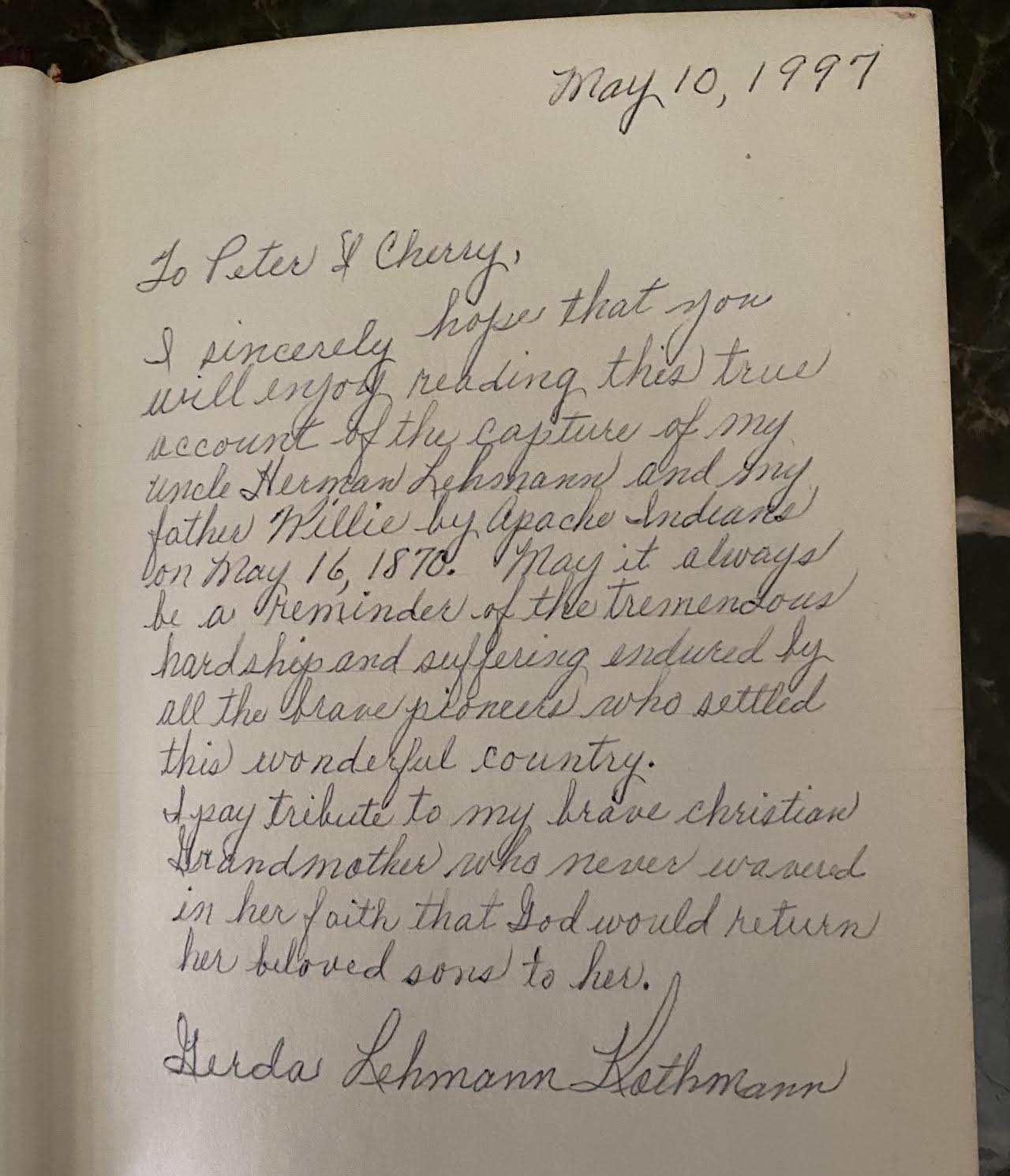
Willie, on the other hand, did very well in life, probably because he was not held captive long enough to have lost his “personal identity” to his captors. He likely looked back on his kidnapping as one of the great adventures of his life, one in which he beat the odds and came out whole. Willie married for a second time after the death of his first wife, and this second marriage produced two daughters, Gerda and Esther. The copy of the book that I now own was inscribed by Gerda to family friends in 1997 (some sixteen years before her death at age 94). I’ve attached a copy of that inscription and a picture of Gerda and the rest of her family (from the book) that was taken around 1930.

Bottom Line: A New Look at Nine Years with the Indians is a fascinating account of what life was like in central Texas right up into the 1880s. It was a time in which farmers and prospectors daring to push further and further west were in constant danger of being picked off by raiders from several different Indian tribes that considered that part of the country to be their own. Not surprisingly, this is not a politically correct book and it displays numerous unconscious racist overtones when describing the Indians and their way of life. For instance, Willie is described on page 271 as having been “taken away by animal-like men” and Herman tells an “amusing” story on page 180 about a black man who was forced to dress as an Indian during one skirmish with Rangers so that the Rangers would mistakenly kill him as he ran for his life back toward the Texans. Herman Lehmann was a real life Little Big Man, no doubt about it.

Gerda's Handwritten Inscription