A nineteen-year-old book blog offering book reviews and news about authors, publishers, bookstores, and libraries.
Sunday, July 10, 2016
July: Books, Baseball, Bluegrass Music, and a Whole Lot of Driving
Just in case anyone is wondering, I haven't disappeared for good. It's unusual for me to go three days without posting something "bookish" here, but I've been attending a youth baseball tournament with my grandson's team for three days of two games per day this weekend, and that's kept me from posting. I have, in fact, been lucky to get some reading in but that's been about it. So now I'm behind on writing at least two book reviews and have another two coming up this week, looks like. But it's been great fun and worth the lost time.
If any of you are curious, his team finished fourth after being eliminated late this afternoon by the number one seed in the tourney in a last-inning 4-3 defeat. (The teams are made up of 14-to-15-year-old boys and my grandson is a catcher/outfielder on his team).
The second half of July is going to be even more hectic for me because I'm leaving for Columbus, Ohio, on the 16th for a four-day bluegrass music festival that begins on the 20th. I allow three or four days on both ends of the festival for the driving, so I may go "dark" for a day or so a few more times in July. This year is especially iffy because I'm still recovering from my broken hip (surgery was May 7) and will be moving even slower than usual.
But stay tuned...I do hope to post here quite a few times while I'm on the road, be it music news, book news, or whatever catches my eye as I drive northeast from Houston. Hope to see you here.
Labels:
Blog News
Thursday, July 07, 2016
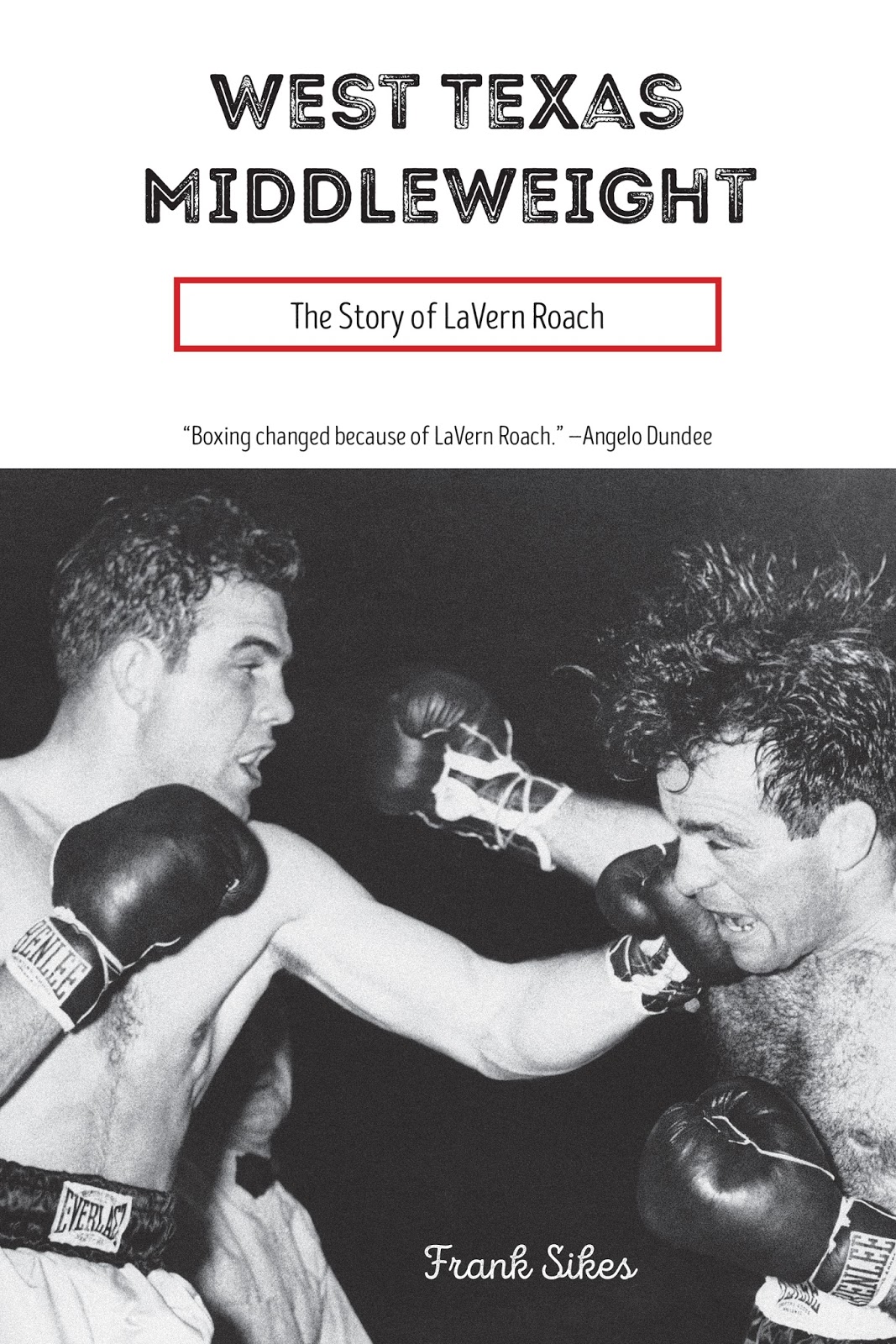
West Texas Middleweight
WEST TEXAS MIDDLEWEIGHT
The Story of LaVern Roach
(Sport in the American West Series)
by
Frank Sikes
Genre: Biography
Publisher: Texas Tech University Press
Date of Publication: June 30, 2016
Number of Pages: 288
Scroll down for Giveaway!
LaVern Roach, a skinny kid from the small town of Plainview, Texas, rose from obscurity to become one of boxing’s most popular figures during the 1940s. Roach’s rise to prominence occurred during an era when boxing shared the spotlight with baseball as the nation’s top two professional sports. As a result of Roach’s death—which marked the first nationally televised fight during which a boxer died from injuries received in the ring—the sport of boxing came under closer scrutiny by the general public than ever before.
West Texas Middleweight is the story of Roach’s all too brief journey from a West Texas amateur, to enlistment in the US Marines, where he captained the nation’s most successful military boxing team, to becoming a Madison Square Garden main eventer. He received the distinction of being named The Ring Magazine’s “Rookie of the Year” for 1947 and was considered a top ten contender for the middleweight championship of the world. This book chronicles Roach’s road to his final fight—and it explains why, as noted by legendary boxing trainer Angelo Dundee, “boxing changed because of LaVern Roach.”
PURCHASE FROM TEXAS TECH PRESS:
http://www.ttupress.org/
email: ttup@ttu.edu
phone: 800.742.2982
Middleweight boxer LaVern Roach was a very successful
professional boxer from the end of World War II to early 1950 but today his
name is a relatively unknown one even among boxing fans. But despite being unfamiliar with the name
LaVern Roach, I was very familiar with several of the boxers who were his
biggest rivals at the time for the middleweight world championship, names like
Rocky Marciano, Sugar Ray Robinson, and Jake LaMotta. And now, thanks to West Texas Middleweight: The Story of LaVern Roach, the new LaVern
Roach biography from Frank Sikes, I can add Roach to my limited understanding
of that boxing era.
LaVern Roach was born in 1925 in a small farming community
just north of Plainview, Texas, in a part of the state known as the Texas
Panhandle. He discovered the sport of
boxing as a ten-year-old when their father gave LaVern and his younger brother boxing
gloves as Christmas presents. LaVern
immediately took the sport seriously, and when he wasn’t fighting his brother,
he was trying to organize matches with neighborhood kids. By the time he reached high school, LaVern
had devised a training routine of his own that rivaled those of professional
boxers of his day, and he seemed destined to join those fighters in the
profession after high school.
But something called World War II intervened, and five days
before his eighteenth birthday (and his high school graduation ceremony),
LaVern joined the United States Marines. The Marines recognized his exceptional boxing
skills and LaVern was made part of the Marine boxing team that fought other
teams as part of the effort to sell war bonds and boost overall morale. During this period, LaVern also met the man who
would be instrumental in guiding his professional boxing career at the end of
the war: Sergeant John Abood, manager of the Marine boxing team.
LaVern Roach began his professional career after World War
II ended, but before his discharge from the Marines, and he was immediately
successful, winning four of his first five fights by knockout before losing for
the first time to an immensely more experienced boxer who disguised his true
identity in order to get the match. As an
amateur, he had a record of 100 wins and 5 losses (with four of the losses
coming before he turned eighteen), so his fast start as a professional was not
a surprise to those in the sport. His
unusual good looks and his success made him one of the more popular boxers of
his day, and LaVern Roach seemed destined for great things.
Author Frank Sikes does not limit “the story of LaVern
Roach” to his exploits in the boxing ring, however. The reader learns of aspects of LaVern’s
personal life (his childhood, his parents, his school days, and the love of his
life, Evelyn Roach and their children) that give a clear picture of how fine a man
LaVern Roach was. To this day Plainview
High School chooses one of its senior boys for the LaVern Roach Award, the
highest honor that a Plainview High School senior boy can attain because it is
given to the boy who best embodies the LaVern Roach lifestyle of “clean living,
good citizenship, and sportsmanship.”
West Texas
Middleweight does LaVern Roach proud.
Frank Sikes, a third-generation West Texan, grew up in Plainview, where LaVern Roach, along with Jimmy Dean, were hometown heroes. Sikes graduated from Texas Tech in 1967, then was a US Navy Officer proudly serving aboard the USS Little Rock stationed in Gaeta, Italy from 1968-1970. He attended the University of Houston School of Business, from 1973 to 1975, and got his master's degree in religion from Wayland Baptist University in 2011.
Frank and his wife Nancy have been married for 50 years and have two grown children out of the house, and two Boston Terriers, Molly and Maggie (or as some suggest Boston terrorists) who rule the house. Lubbock has been home for the past 30 years with stops in Newport, RI; San Francisco, CA; Gaeta, Italy; Houston, TX; and Albuquerque, NM. West Texas Middleweight is his first book.
Connect with the author on FACEBOOK.
---------------------------------------
GIVEAWAYS! GIVEAWAYS! GIVEAWAYS!
3 WINNERS:
Each Wins a Signed Copy of the Book
plus
2 GRAND PRIZE WINNERS:
Each Wins a Signed Copy of the Book PLUS a $25 Barnes & Noble Gift Card
(US ONLY)
June 1 - June 10, 2016
CHECK OUT THE OTHER GREAT BLOGS ON THE TOUR:
7/1 Country Girl Bookaholic – Review
7/2 My Book Fix Blog – Author Interview #1
7/3 Forgotten Winds – Guest Post #1
7/4 Margie's Must Reads – Review
7/5 Blogging for the Love of Authors and Their Books – Promo
7/6 StoreyBook Reviews – Author Interview #2
7/7 Book Chase – Review
7/8 The Page Unbound – Author Interview #3
7/9 Missus Gonzo – Guest Post #2
7/10 It's a Jenn World – Review
blog tour services provided by
Labels:
Reviews
Tuesday, July 05, 2016
St. Louis Noir
St. Louis Noir is
just the latest of about a dozen of the short story collections in this Akashic
series that I’ve read now, and the streak continues – not a single one of them
has disappointed me. Each of the
collections begins with an introduction from the book’s editor (in this instance,
Scott Phillips) that helps set the overall tone for what is to follow. As Phillips says, the St. Louis region has
not had an easy time in recent years, and that makes the city the perfect
setting for this kind of hardcore crime fiction. Consider that one of Phillips’s definitions
of noir is fiction that “traffics in fatality and doom and bad luck and
characters who persistently, knowingly, act against their own best interests”
and you have an idea of what is to come.
Among my favorite stories in St. Louis Noir is one called “Deserted Cities of the Heart” (by
Paul D. Marks) in which a loner of an IT nerd with a security clearance is
convinced to hack into a witness protection data base with disastrous results
by the attractive young out-of-towner who suddenly comes into his life. Another is “A Paler Shade of Death” (by
Laura Benedict) about a young woman that many suspect is guilty of killing her
four-year-old son. Now that her marriage
has fallen apart, she is trying to convince herself that it is time for a fresh
start – but is it? Two other stories are
particular standouts: “The Brick Wall” (by John Lutz) and “One Little Goddam
Thing” by the collection’s editor Scott Phillips. The first is a rather Hitchcockian story
involving revenge of the most ingeniously delicate variety, and the second
involves revenge of the cruder, but equally effective, type.
St. Louis Noir also
includes what is titled “A Poetic Interlude,” four short poems from Michael
Castro. In very few words, the first two
pieces (“In St. Louis Heat” and “Gaslight Square”) paint vividly memorable
pictures of St. Louis street scenes, but the third poem, “St. Louis Blues
Revisited” strikes a note I wish it had not stricken by referencing “the cold
cop who killed Michael Brown.” Perhaps I
am misreading the poet’s intention in making that reference, but I do not see
that it adds much of anything to mood of the poem, even coming in the poem’s
very first stanza as it does. Much worse
is a similar reference in author Umar Lee’s short author biography (whether written
by Lee or by the editor did, I do not know) to the “murder of Michael
Brown.” That reference serves no purpose
whatsoever other than to explain the politics of Umar Lee who is “presently a
candidate for mayor of St. Louis.”
The bottom line: St.
Louis Noir is another worthy addition to what is perhaps already the best
series of short story collections to be published in decades.
(Review Copy provided by Publisher)
Labels:
American Noir,
Reviews
Subscribe to:
Comments (Atom)