Wednesday, September 07, 2011

The Paradise Prophecy


This is not meant as some kind of backhanded complement, but in comparison to many other books in the supernatural/horror/conspiracy theory thriller genre, Robert Browne’s The Paradise Prophecy is well written.  The genre has gotten so formulaic (probably due to Dan Brown’s huge success in exploiting the ever more weary formula) that what most distinguishes the books from one another these days is the quality of the writing.  In that sense, Robert Browne excels with this one even if his plot execution (particularly the book’s ending) is predictable.  I realize that it is probably too much to expect an author to write one of these books where the “bad guys” actually win, and that has become my problem with thrillers.  In this case, knowing that good would almost certainly find a way to win over evil, I found myself racing through the final chapter of The Paradise Prophecy only to see how the “good guys” would pull their chestnuts out of the fire at the last second – not to learn who would actually win the book’s final battle.  I say this with no fear of spoiling the book’s ending for other readers; after all, how else would they expect it to end?

The Paradise Prophecy is an epic battle of good vs. evil, perhaps even the final such battle.  Since God seems to have lost interest in the world, a small group of dark angels (Belial, Moloch, Mamman, and Beelzebub) are hoping to use the opportunity to take over and open the gates of hell to free Lucifer for his return to Earth.  Michael, a fallen angel who has not embraced the dark side, with his own small team of exceptional humans, is all that stands between the demons and their plot to destroy the world we know. 

The “prophecy” in question is believed to have been written on the seven pages missing for centuries from what has become known as “the Devil’s bible.”  What these pages have to say is so powerful that it can change the universe forever – for better or worse.  The pages are thought to be somehow connected to John Milton’s Paradise Lost and several of Michael’s human cohorts are, when the book begins, busy trying to crack the code and clues they believe Milton has buried in his manuscript.

The most interesting part of The Paradise Prophecy does, in fact, involve the research and detective work accomplished by the book’s two main characters: Louisiana professor “Batty” LaLaurie and a special agent of the State Department, Bernadette Callahan.  Callahan and LaLaurie, working as a team, travel the world in search of clues but, because they are always one step behind the murderous dark angels, the bodies begin to pile up.  Callahan, at first a skeptic of anything supernatural, is only slowly convinced by LaLaurie’s explanation of the evidence they uncover that she is dealing with something otherworldly.  All of this, of course, leads to the final confrontation between good and evil in which the fate of mankind will be determined.

Rated at: 3.0

(Review Copy provided by Publisher)


Tuesday, September 06, 2011

You Had Me at No James Patterson, Mr. Toews

Rock Toews
Man, I hope this bookstore manages to survive.  It's only been open since March, so it's too early to predict its future - but this sounds exactly like the kind of bookstore that book lovers everywhere would hope to have in the neighborhood.

I have to admit that the store had me hooked as soon as I saw the introduction to this article:
You won't find any Danielle Steele, James Patterson...novels at Back Creek Books. And not because owner Rock Toews is sold out.
Mr. Toews is a lot more politically correct than me; he says he doesn't stock that kind of thing because it is so readily available everywhere else.  I, on the other hand, applaud him for having the courage to give up the revenue he would probably generate from selling that kind of crap and focusing instead on the high quality, unique items that make Back Creek Books such a special place.

A quick glance of the tables and shelves reveals a reprint of Davy Crockett's almanac, a treatise on Atlantic salmon fishing, a collection of Willa Cather's works, a concise history of the Marine Corps, a 1930 biography of Benedict Arnold, and a large volume on artist Leroy Neiman.

Toews also has a pamphlet on the Annapolis budget from 1885, a letter from a solider convalescing at the hospital established at the Navel Academy during the Civil War, and even sheet music and lyrics to "Maryland, My Maryland" from 1862.
All of the items are used, save a few recent publications on local history, such as "Annapolis, City on the Severn: A History" by McWilliams. Used books are priced from $3 up to $3,000 (for a book featuring a scandalous attack on Thomas Jefferson written the year he died).
"I want there to be stuff you don't see everywhere else," said Toews, who lives near Back Creek in Eastport and is a married father of two children, 11 and 12.

(This Theresa Winslow article was originally published in The Capital of Annapolis but I found it reprinted in the 9-6-11 edition of the Houston Chronicle.)

Rock Toews also has an interesting website for Back Creek Books that is worth checking out.  Do take a look.

Sunday, September 04, 2011

Doc


I am willing to bet that a substantial portion of adults recognize the name Doc Holliday when they hear it.  But I am more willing to bet that most of them know nothing of Doc’s life other than that he was skinny, had a bad cough, was a cardsharp, and participated in Tombstone’s Gunfight at the O.K. Corral.  After all, that’s about all Hollywood has much bothered to tell us. 

Mary Doria Russell is here to help remedy that; Doc, her 2011 western novel, admirably fills in the blanks, turning Doc Holliday into a living, breathing human being in the process.  The very first paragraph of the book places readers on notice that they are beginning a tragic novel, not some Buffalo Bill’s Wild West Show version of the Old West: 
            “He began to die when he was twenty-one, but tuberculosis is slow and sly and subtle.  The disease took fifteen years to hollow out his lungs so completely they could no longer keep him alive.  In all that time, he was allowed a single season of something like happiness.”  (Page 3)
Holliday found his way to Tombstone, Arizona, only after being convinced it was time to close up shop in Dodge City, Kansas, where he and the Earp brothers had managed to carve out a living for themselves.  Russell’s description of Dodge and what life was like there during the town’s peak years is relatively close to the portrait most often painted by television and movies.
            “The facts were these.  Dodge City did not invent or manufacture goods.  Dodge did not raise or educate children.  It did not nurture or appreciate the arts.  Dodge City had a single purpose: to extract wealth from Texas.  Drovers brought cattle north and got paid in cash; Dodge sent them home in possession of neither.”  (Page 28)
But from Russell’s account of Dodge City, it is evident that the everyday existence of men like the Earp brothers was a good bit tamer than one has commonly been led to believe.  Gunfights occurred, of course, but they were far from being a daily or even a weekly affair.

Doc with Kate Elder
From the Armand de Gregoris Collection
No, Doc is a book about real people living real life, and Russell does her best to distinguish between myth and reality.  She explores personality, motivation, character, background, and chance as it impacts her novel’s main characters: Doc Holliday, Kate Elder (as Hungarian Maria Katarina Harony came to be known), Wyatt Earp, Morgan Earp, and Virgil Earp.  Even prone to violence, gambling, drinking, and whoring as these people were, Russell succeeds in making sympathetic (and human) characters out of each of them.  Take, for instance, this passage describing Morgan Earp as seen through the eyes of his mother:
            “Even when he was little and just listened, Morg loved the feel of a book in his hands, loved the pictures books drew inside his head, loved even the smell of paper, and leather binding, and glue.  Lord, but it did Virginia’s heart good to watch that child with a book, his solid little body almost motionless while his mind traveled.  And she admired the way Morgan helped Wyatt with his lessons instead of making fun of him, like the older boys did.”  (Page 129)
Russell makes this love of books and reading a key characteristic of several characters, in fact, as Morgan, Doc, and Kate talk books and literature, and even read the great Russian novelists.  I think it is safe to say that this is an aspect of their personalities seldom exploited by Hollywood.

Doc, then, is a novel for those who want to learn the truth about Doc Holliday, the Earps, Kate Elder, Dodge City, and Tombstone.  If that describes you, this is a book you will not want to miss.

Rated at: 5.0


Saturday, September 03, 2011

Sinful Saturday: A Celebration of Pulp Fiction Art

(Image from the Flickr account: Vintageillu's Photostream)


The cover art of these old pulp fiction/paperback originals makes the books quite collectible and hard to find these days - especially in anything approaching decent condition.  They were never a very high quality product - and that includes both the stories and the paper and cardboard upon which they were printed.  But it is great fun to look back on them some sixty or so years later.

The Lustful Ape was written in 1950 by Bruno Fischer (not a bad writer) but here he used the pen name Russell Gray which he had already been using for several years.  It is a 65,000 word novel that Mr. Fischer completed in a mere 18 days and, as you can see from the cover, it sold for a whopping 25 cents in 1950. The cover art was produced by Julian Paul.  From what I can gather, the "ape" was a menacing musclebound character, probably the villain of the piece.  Bruno Fischer is also known as one of the earliest writers to produce work for the "paperback originals" market.

Friday, September 02, 2011

Borders - The Woodlands, TX, 9-2-11

There's only one Borders bookstore within easy driving distance of me, and I decided to pay it a visit this morning in order to kick my four-day weekend off on the right foot.  It was my first trip to Borders since the bankruptcy announcement and the beginning of the liquidator's efforts to get rid of everything in the stores.  I am under the impression that these are the final markdowns to be had before everything is packed up in a few weeks.  As these things go, I never bother to buy anything until near the end (after the original rip-off markdowns have been used to take advantage of the more gullible consumers among us), and I figured it was time to take a look.

I see no point in buying anything at a cheap price just because it is a good deal - but I did manage to find four books that I am happy to add to my shelves (well three to the shelves and one that will probably just be read and put in a closet for now).

Some of you know that I am a collector of Joyce Carol Oates books, with something over 90 books of hers on my shelves.  Well, I was able to find two that I didn't have: a paperback copy of her Sourland short story collection and a hardback first edition of her collection called Give Me Your Heart.  There were actually two others in the store I thought I had, but it turns out I must have read library copies, and don't have them at home.  That means a return trip to Borders in the next day or so, I suspect.

I also found a hardback called If Trouble Don't Kill Me, that I've had on my wish list for a while but never got around to ordering on the net.  It's the story of the Hall brothers, a couple of thriving bluegrass music performers who had their brief careers wrecked by the onset of World War II.  Theirs is supposed to be quite a story, and I'm really happy to add this one to my collection of musician biographies.

And, last and probably least, because I had just read C.B. James's review of it, I recognized the title A Novel Bookstore and grabbed a copy of it in paper for a measly $4.50.  It looks interesting - and I'm a born sucker for novels or movies that feature bookstores, so it was a no-brainer purchase.

I also snapped a few pictures of the store but all I had with me was my iPad and the camera on that thing is nothing to write home about.  The pictures do, however, give a good feel for what Borders stores are starting to look like at this point.

Thursday, September 01, 2011

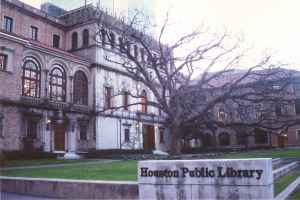
Library Thieves Find Easy Pickings in Houston

In case anyone might be thinking that I only enjoy throwing rocks at librarians and library patrons in other states, I want to share an article that I spotted in the Houston Chronicle last week.  The article describes in great detail what has been going on within the Houston Public Library system since 1999 - and it's not pretty.  As Chronicle reporter Yang Wang jokingly points out, however, there's both good news and bad news in this story.  The good news is that "borrowers" really like books; the bad news is that they like books so much they have failed to return almost a quarter of a million of them in the last 12 years.
The library scofflaws owe city taxpayers nearly $12 million for filching books, CDs, maps, periodicals and even laptops over the last 10 years.
One library poacher owes the city $5,658 for never returning 229 items, including 140 books, 24 audiobooks and 20 video discs. At least 200 borrowers owe more than $1,000 in fines.
How does it happen? Easily, it turns out.
Borrowers simply provide a valid photo ID with their current address to get a library card, and then they can check out as many as 50 items at one time.
Before 2005, library-card holders were able to borrow an unlimited number of materials at one time, and it wasn't unusual for some to check out hundreds of taxpayer-funded items.
The article is not bashful about naming the culprits and even managed to track down one of them who seems to have lost the sixteen books she checked out (valued at $400).  Of the top 10 offenders on the list, not a single one of them has bothered to pay a fine or return the materials stolen.  You know things are not going well when the city legal department refuses to get involved and the debt collectors hired to recover from these thieves are failing to do much good (about a 10% recovery rate when they are used).

To rub salt in the wounds inflicted by these lowlifes, the Houston Public Library is making its services available on a reduced schedule because of budget problems.   Letting several million dollars worth of books, DVDs, laptops, CDs, and audiobooks walk out the front door is not helping much.