Thursday, August 05, 2010

Blog Design Changes - Good, Bad, or Ugly?

I've been bored with my blog template for months now, but I can't seem to find anything close to what I'd like to change it to.  Blogger offers endless combinations within their new templates but I'm disappointed to find that none of the new templates take full advantage of the width of the display.  There just seems to be too much wasted space on the edges of the presentation - but then I don't claim to have an artistic bone in my body, so maybe it's just me that sees it that way.

Anyway, I'm going to try something similar to what you see at the moment, with a little more fooling around with the details and lineup along the sidebar yet to come.  I do like that the posts seem easier to read with this layout, and that's the main thing because staring at a computer screen all day long is already hard enough on the eyes. Regardless of where I end up with all this tinkering, the old look seems gone forever because I managed to overwrite it early on and it now seems to be an irretrievable thing of the past.

Please tell me what you think of the new look.  I know it's a drastic change, so let me know whether or not it works for you, and if it is any easier to read on your particular display.

Wednesday, August 04, 2010

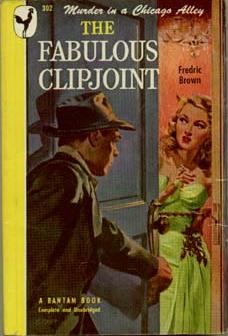
The Fabulous Clipjoint

The Fabulous Clipjoint is one of those books I would have missed out on if not for the relative ease with which copyright-expired (and, usually, out-of-print) books can be downloaded from the internet these days. Frankly, prior to discovering this title on the net, I knew nothing about Fredric Brown’s writing career or about The Fabulous Clipjoint, his first novel. What caught my eye was the cover art of the book’s original 1947 edition – one glance, and I knew I had to read this one.

From the cover, I expected a hardboiled piece of American noir style detective fiction, the kind of stuff that is still so popular with readers today. And I got that, plus a big surprise. The Fabulous Clipjoint is also a fine coming-of-age novel about Ed Hunter, an 18-year-old boy whose father is murdered late one night in one of Chicago’s back alleys. The elder Hunter, apparently on his way home from an evening of local bar-hopping, never made it. Ed was not particularly happy about his home life even before his father’s murder but, now that he is stuck at home with just his alcoholic stepmother and his randy 15-year-old stepsister, life at home is trickier than ever.

Things get interesting when Ed’s Uncle Am (Ambrose) shows up to help the family through its grieving process. Am runs a game of chance in a traveling carnival that just happens to be passing through Chicago at the time of his brother’s murder. Am is determined to identify the killer and, since Ed’s boss has given him a few days off from the printing shop he works at, he decides to help his uncle nose around Chicago’s north side.

Am knows that his amateur investigation will bring him and Ed into contact with the thugs and lowlifes that thrive in Chicago’s criminal underbelly. If they are to achieve their goal – and survive the process – the Hunters are going to have to be as tough and fearless as those they want to intimidate into telling them the truth about what happened to Ed’s father in that dark alley. Am, world-wise and rough enough around the edges to pull off a tough guy image, begins a makeover of young Ed that is half the fun of the book. Before long, Ed, dressed in his new tough-guy-suit, finds himself bluffing his way through confrontations with thugs and their women in a way he could not have imagined himself doing even a few days earlier.

This one is fun on several different levels, among them: its hardboiled look at big city life just after WWII; the nurturing relationship that develops between Ed and Am; the ease with which Ed grows into playing “gangster;” and the feeling of nostalgia that reading something from this period always generates.

The Fabulous Clipjoint won an Edgar for “Best First Novel” in 1948 and, as it turns outs, was the beginning of a series of seven “Ed and Am Hunter” novels written between 1947 and 1963. In addition to the Ed and Am series, Brown wrote at least twenty other novels in the fifties and early sixties, most of them science fiction. He is also the author of numerous short stories. I look forward to experiencing more of his work – in both genres.

Rated at: 4.0

Tuesday, August 03, 2010

Raining Books in New York

Monaster/News, Thomas
Here we go again with another sad case of book trashing.  I realize that putting soon-to-be-junked books into the hands of readers who would really appreciate them is a lot easier said than done.  And, in this particular case, it appears that the folks just ran out of time to move the books to new, appreciative homes - or, at least, they claim they did.

According to the New York Daily News, this is what happened:
It was raining books outside St. Michael's Academy in midtown Monday.


The Education Department not only threw out thousands of books left in the building it is leasing from the Archdiocese of New York - it tossed them out the windows.
[...]
A massive stack of textbooks and literary works such as "Death of a Salesman" and "Sophie's Choice" sat piled more than 6 feet high on W. 33rd St. outside the building that will house the Clinton School for Writers and Artists in the fall. St. Michael's closed in June.


Archdiocese officials said they gave away as many books as possible before moving, but they ran out of time.


"When you close a school, there's an awful lot of work to do," said Mike Radice, who was in charge of the closeout of St. Michael's last spring.


The Education Department admitted to the trashing.


"There was no agreement with the archdiocese to save the books," a spokeswoman said. "We are recycling them." 
This does seem to be a combination of circumstances almost guaranteed to ensure that thousands of books would be destroyed rather than given away.  But, I still have to wonder why one or two people could not have stepped up and made all the difference, even in a situation where lack of time was the main culprit.  But was there really so little time?  Note the two words I've highlighted in red in the newspaper account of what happened.  These books apparently sat inside the school for several weeks before everyone "ran out" of the time needed to move them.

Just one guy from the Education Department willing to go the extra mile to coordinate with someone working with the Archdiocese of New York, or vice versa, could have made all the difference.
Where are book lovers when you need them?  Unfortunately, in this case, they were standing outside the school fence watching books fall from the sky.

Monday, August 02, 2010

Perfect Reader

Maggie Pouncey’s debut novel, Perfect Reader, tells a strong character-driven story about ordinary people who unexpectedly find themselves sharing the same life crisis:

Flora Dempsey, 28 years old, has been called back to Darwin to deal with the sudden death of her father, Lewis, a retired college president who was still very much a presence in this small college town right up to the day of his death. Cynthia is the lover Lewis Dempsey left behind, a teacher still employed by Dempsey’s old school, and someone whose very existence comes as a shock to Flora. Cynthia had hoped to spend the rest of her life with Dempsey – but now he is gone. Joan is Flora’s mother, the woman who divorced Lewis Dempsey almost two decades earlier precisely because she could not stand playing the “president’s wife” role assigned to her by small-town academia - and who is still angry that her ex-husband ever had the nerve to expect her to fill that role.

Flora is an unhappy young woman. She is not satisfied with her life in the big city, including the magazine job that makes that life possible, so she is almost eager to walk away from it all to begin a new one in the house she has inherited from her father. When she meets her father’s lawyer, a man whom she sees as a potential lover of her own, Flora learns she has inherited more than just the assets her father left behind. She has also inherited the obligation of serving as his literary executor and now she will have to decide whether the poems her father entrusted to her care will ever be published.

By entrusting his daughter with his final work, Lewis Dempsey may have been hoping to find his own “perfect reader,” that person who would read his poems exactly as he intended them to be read, with complete understanding of their message and source. Realistically, such a thing is near impossible to achieve and, in the case of the Lewis Dempsey and his daughter, their complicated relationship will doom it from the start.

Flora will spend much of her time in Darwin, a town she feels is “three hours from everywhere,” being reminded of her unhappy childhood there. Pouncey skillfully interweaves stories from Flora’s childhood about sharing time with both parents after the divorce, and about a devastating incident involving her best friend, with the current day experiences that trigger those memories. In the year-long process, Flora will learn as much about her own life as she does about her father’s and about the woman she has come to see as such a rival to her father’s memory.

Perfect Reader will particularly appeal to those readers who enjoy delving deeply into the heads of a novel’s characters and those with an interest in the inner workings of a small town college. This one is not long on action or plot twists, but it leaves the reader with plenty to think about.

Rated at: 4.0

(Review Copy provided by Publisher)

Sunday, August 01, 2010

Me and Mac

The hard drive on my old PC has been teetering on the brink of destruction for weeks now and it finally got to the point where I could no longer ignore its creakiness and reluctance to crank up for another day's work.  I knew something had to be done but I was finding it hard to pull the trigger on buying a replacement PC for the sick one because, over the years, I have come to believe that planned obsolescence of PCs is all a big plot to force me to buy replacement software every few years.  Bill Gates and company always manage to kill some of my favorite software when they come out with a new version of the Windows operating system.  The other software companies seem to have little incentive to offer the fixes that would make their older versions compatible with "Ultimate Windows" because, of course, they would rather have the customer return to buy the version that does work with Ultimate Windows or next year's Best Windows Ever.

Well, I refuse to play that game anymore.  Instead, I ponied up for my first iMac yesterday afternoon.  And now I'm faced with the huge task of moving all my old files over to the iMac so that it will do all the things I need it to do.  It is a relatively easy process, I find, to move things over to the Mac from my backup drives; the kicker is getting them to open up in the iMac software.  But even though this is my first ever exposure to working on an iMac, I continue to make steady progress - although I did have to make a run to Barnes & Noble this morning to find an illustrated user's manual that could explain a few of the things that had me stumped.

So far, I have only destroyed one thing - well, at least, so far as I can tell.  Somehow, I managed to lose everything in the inbox of my main email account, the one tied here to Book Chase, in fact.  I remember there were close to 70 emails in that box, so I apologize if I've deleted anything that required me to respond to any email from here.  I'm still hoping I'll find the inbox sitting safely in some snug little corner of Mac's big file room but, so far, that hasn't happened.

All of this computer time has limited both my reading and my posting this weekend - and I'm starting to wish I had made the switch a year ago when I first considered it because this is a snazzy machine, and I'm loving it already.  I suspect that this time-challenge will last for another few days, though, so bear with me as I struggle to get all the way back to square one again.  What is it they say about the journey again?

Friday, July 30, 2010

Why Not Give Away E-Book Readers?

So Amazon has announced a new, slimmed down version of the Kindle selling for only $139 and the company is taking pre-orders now for delivery at the end of August.  This is the cheapest Kindle to-date and it will further accelerate the e-book reader price war that's been brewing for the last few weeks.  This is all good news for those in the market for these devices, of course, and it will be interesting to see where prices bottom out.

But this has me wondering if e-book makers such as Amazon, Sony, Barnes & Noble and Borders aren't using the wrong business model.  After all, the real revenue stream, and the most profit, for these companies will come from selling e-books to those who own one of their devices.  Each of these companies has an online bookstore from which new e-books can be downloaded to the readers, and the expectation is that those who have readers will need an endless supply of reading material.  Makes sense.

So why don't the Big Four makers mark the readers down to something like $50 a pop?  Get those readers into the hands of readers and then sell the heck out of e-books to them.  Lock them in to your device and then aggressively market your continuing service to them.  Heck, why not use the safety razor business model and send coupons out to targeted readers offering them free devices?  How better to gain instant market share and ensure long term profits?

Of course, this will not work for the makers of the more generic readers not supported by their own online bookstores.  But, I suspect, even these manufacturers would find a way to make more money if the overall e-book market expanded by a factor of ten or more.

In the meantime, I'm watching with interest to see how all this shakes out.  I suspect there will be more losers than winners if things keep going the way they are.  Is anyone brave enough to try my suggestion?  I sincerely doubt it, but wouldn't it be fun if one or two of them decided to give it a shot?